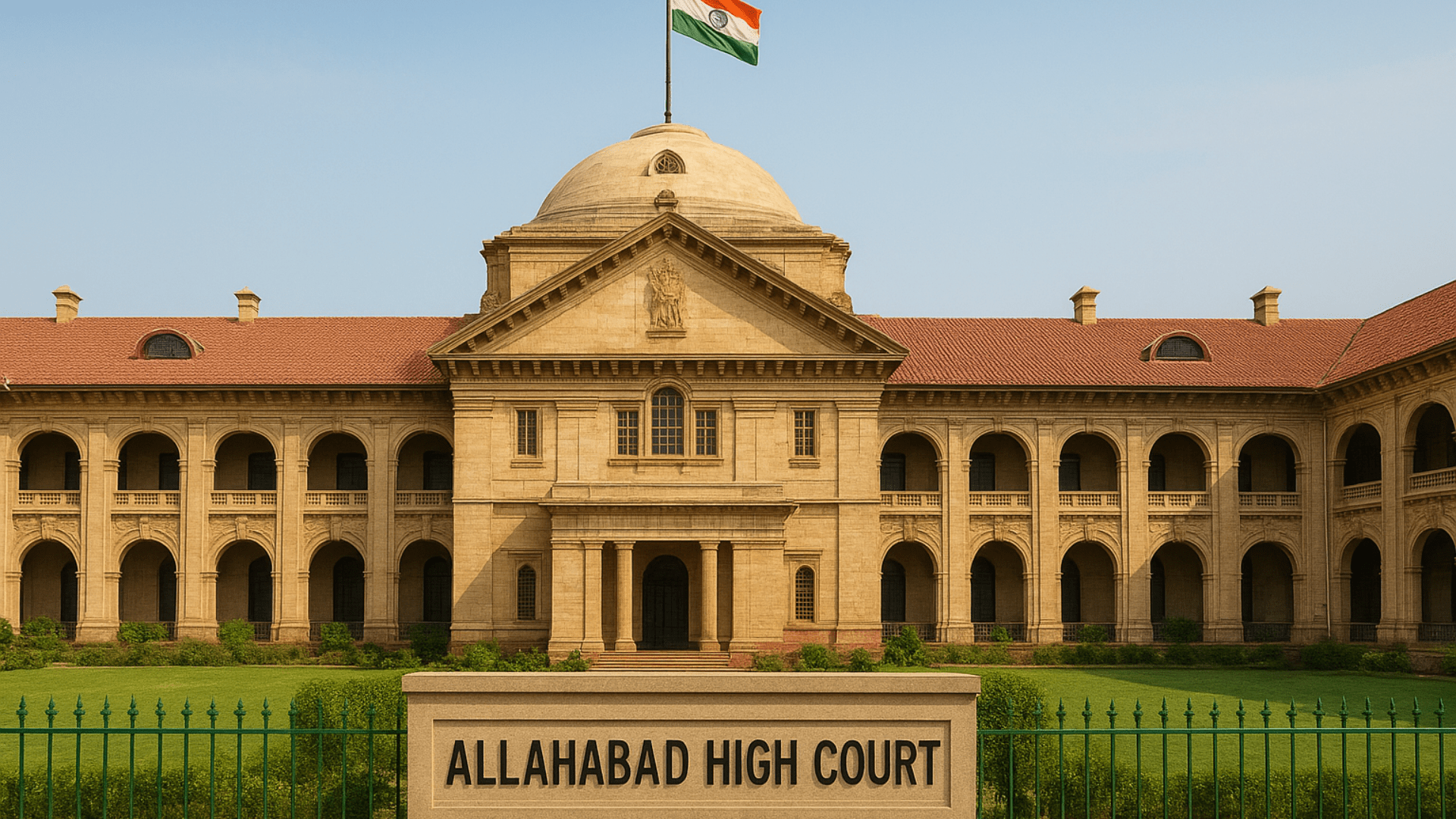
The Allahabad High Court, while clarifying the principle of double jeopardy in service rules, has held that awarding a second punishment to an employee on the basis of the same allegations and facts is not only illegal but also a serious violation of the principles of natural justice.
The Court observed that – “It is the settled position of law that a punishment order has to be passed by following the proper procedure as prescribed under law, which has not been done in the present case.”
The said order was passed by the Single Bench of Justice Manju Rani Chauhan, allowing the writ petition filed by Rajendra Prasad Srivastava and completely quashing the punishment order dated 12.07.2023 and the appellate order dated 13.12.2024 issued by the Varanasi Development Authority.
According to the facts of the case, the petitioner was initially appointed in 1986 in the Varanasi Development Authority as a Class-IV employee (Survey Khalasi) on daily wages. After almost 30 years of uninterrupted service, the petitioner was promoted to the post of Junior Clerk, and he was also entrusted with the additional responsibility of Store along with the Records Section. According to the prosecution, he did not move the purchase file forward in time, but the record clearly revealed that the file remained pending with the Store In-charge for 11 days and that immediately upon receiving the file the petitioner processed it without delay. Meanwhile, the Store In-charge filed a complaint alleging negligence and inefficiency against the petitioner. Based on that complaint, a show-cause notice was issued on 15.11.2022 and the salary of the petitioner was withheld even without giving him an opportunity of hearing. The petitioner gave an oral explanation before the Vice Chairman, which was accepted, and on 17.01.2023 the salary was released and the matter was closed with a strict warning to remain careful in future.
According to the petitioner, on the very same day, without giving him a chance to respond again or to inspect records, a fresh charge-sheet was issued repeating the same allegations, and ultimately the petitioner was demoted and sent back to the Class-IV post. The charge-sheet contained two allegations: first, negligence and carelessness in duty and second, delay in submitting necessary information relating to the security apparatus of buildings.
However, petitioner’s counsel Ankit Srivastava and Rahul Srivastava relied upon the Supreme Court judgment Lt. Governor, Delhi and Others vs. HC Narinder Singh and submitted that,
“…………..imposing a second penalty based on the same cause of action amounts to double jeopardy. In the present facts of the case, the petitioner is being punished once again for allegations that were already set at rest after considering his oral submission on 17.01.2023, while the charge-sheet was issued on the same day for the same cause of action.”
The Court further found that, “……….there is nothing on record to show as to how, when once on 17.01.2023 itself the Vice Chairman had already exonerated the petitioner on the basis of the oral submissions made by him, a charge-sheet with the same set of allegations could again be issued against the petitioner on the same day.”
The Court specifically underlined that the petitioner was not given any opportunity to receive the inquiry report or to file objections. The record clearly shows that the Vice Chairman accepted the oral explanation and ordered release of salary with only a strict warning, yet on the same day a second departmental proceeding was initiated on the same allegations. Thus, repeating the same allegations and proceeding behind the back of the petitioner is arbitrary, illegal and invalid in the eyes of law.
Taking all these facts into consideration, the High Court held the demotion to be unconstitutional and illegal, set aside both departmental orders and allowed the petition.
Case: Rajendra Prasad Srivastava vs State Of U.P. And 4 Others