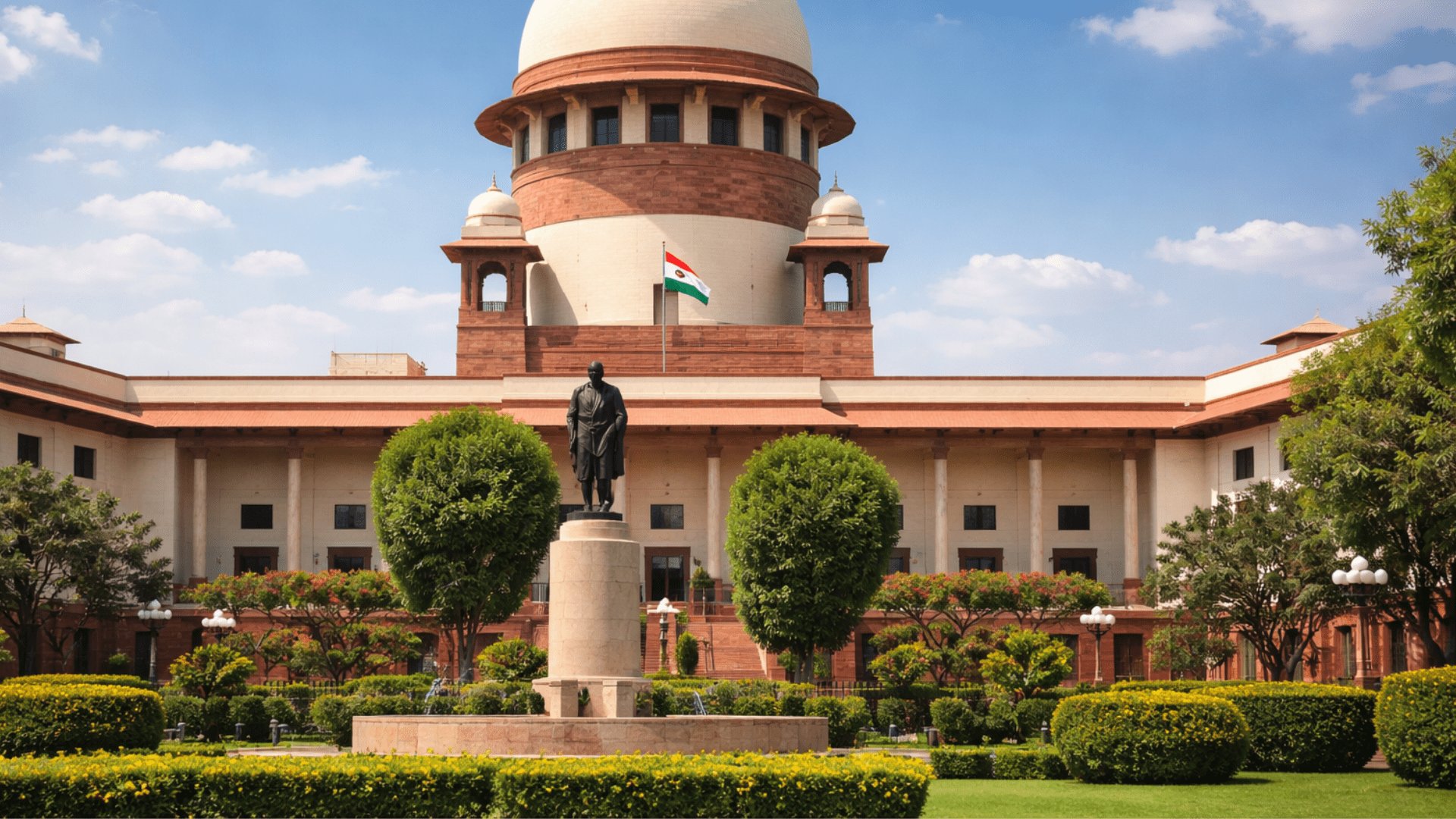
The Supreme Court held that amounts received by the dependents of a deceased employee under an employer-provided group insurance scheme cannot be deducted from compensation awarded under the Motor Vehicles Act, 1988.
The Court ruled that such benefits arise from an independent contractual arrangement and do not constitute a “pecuniary advantage” liable to be set off against statutory compensation.
The aforesaid order was passed by a Bench comprising Justice Pankaj Mithal and Justice Prasanna B. Varale which arose from two civil appeals filed by the Managing Director of the Karnataka State Road Transport Corporation (KSRTC) and an insurance company challenging orders of the Karnataka High Court enhancing compensation awarded in motor accident claims.
In the first case, the deceased, P. Visweswar, aged 34, was riding a motorcycle near Murakambattu in Chittoor district on 30 July 2018 when a KSRTC bus allegedly driven in a rash and negligent manner, crossed to the wrong side of the road and collided with his vehicle.
He sustained grievous injuries and later succumbed to them. His dependents filed a claim petition before the Motor Accident Claims Tribunal (MACT), Bengaluru, seeking compensation of ₹1 crore.
The Tribunal found the bus driver negligent and assessed compensation at ₹69,07,710. However, it deducted ₹35,48,000 received under the deceased’s employee group insurance scheme and awarded ₹33,59,710 with interest at 6% per annum.
Further, on appeal, the Karnataka High Court set aside the deduction and restored the full compensation amount.
Regarding the second case which is related to the death of Celestine Dsouza, a 47-year-old Assistant Manager at Cox and Kings Ltd. On 20 January 2015, she was travelling on a scooter near Johnson Market Junction in Bengaluru when a bus allegedly hit her vehicle from behind, causing her to fall and be run over. Her legal representatives sought ₹75 lakh in compensation.
The Tribunal assessed compensation at ₹63,04,878 but deducted ₹10 lakh received under the employer’s group insurance scheme, awarding ₹53,04,878.
Also read: https://practicinglawyer.in/supreme-court-no-fault-compensation-covid-vaccine-adverse-events/
Later on, the High Court subsequently modified the award and fixed compensation at ₹59,95,944 without deducting the insurance amount.
Aggrieved by the afore-mentioned decisions, the instant appeals have been filed by transport corporation and the insurer.
The bench examined whether amounts received by claimant under employer-provided group insurance could be deducted from compensation awarded under the Motor Vehicles Act.
Moreover, the Court pointed out that compensation under the Motor Vehicles Act is intended to ensure just recompense for victims and their dependents.
Further, the Bench referred the earlier orders as passed in Helen C. Rebello vs. Maharashtra State Road Transport Corporation, United India Insurance Co. Ltd. vs. Patricia Jean Mahajan & Ors, and Sebastiani Lakra vs. National Insurance Co. Ltd. and reiterated that the principle of balancing loss and gain applies only when the benefit received has a direct nexus with the accident.
The Court emphasised that benefits flowing from independent contractual arrangements cannot diminish the statutory entitlement of claimants.
It observed that,
“……..amounts received by the dependants of the deceased under employer-provided group insurance or other contractual or social security benefits cannot be treated as “pecuniary advantages” liable to be deducted from compensation awarded under the Motor Vehicles Act, 1988. Such benefits arise out of an independent contractual relationship and lack the requisite nexus with the statutory compensation payable for death in a motor vehicle accident. The principle of balancing loss and gain cannot therefore be invoked to diminish the statutory entitlement of the claimants to just compensation.”
Finding no error in the reasoning adopted by the Karnataka High Court, the Supreme Court dismissed the appeals.
The Court affirmed the High Court’s decisions by setting aside deductions made by the Tribunals towards group insurance amounts and upholding the reassessed compensation in favour of the claimants.
In light of the above discussion, the appeal was dismissed, along with direction to deposit the award compensation, if it hadn’t already been deposited, within six weeks.
Case: The Managing Director, KSRTC vs P. Chandramauli & Ors.
Date of Order: 16.03.2026
Status: Dismissed