An FIR filed under the Uttar Pradesh Gangsters and Anti-Social Activities (Prevention) Act, 1986 was invalidated by the Supreme Court because the necessary procedures for creating and approving a Gang Chart had not been followed.
The Court emphasized that strict adherence to statutory rules is essential, particularly when individual liberty is at stake.
The said order passed by Division Bench of Justice K. Vinod Chandran and Justice Sanjay Kumar while allowing the appeal filed by Gabbar Singh alias Devendra Pratap Singh Alias Rajesh Singh.
The aforesaid appeals arose from orders of the Allahabad High Court refusing to quash FIR and also review filed against the order which was registered at Police Station Kotwali Nagar, Bahraich, under Section 3(1) of the 1986 Act.
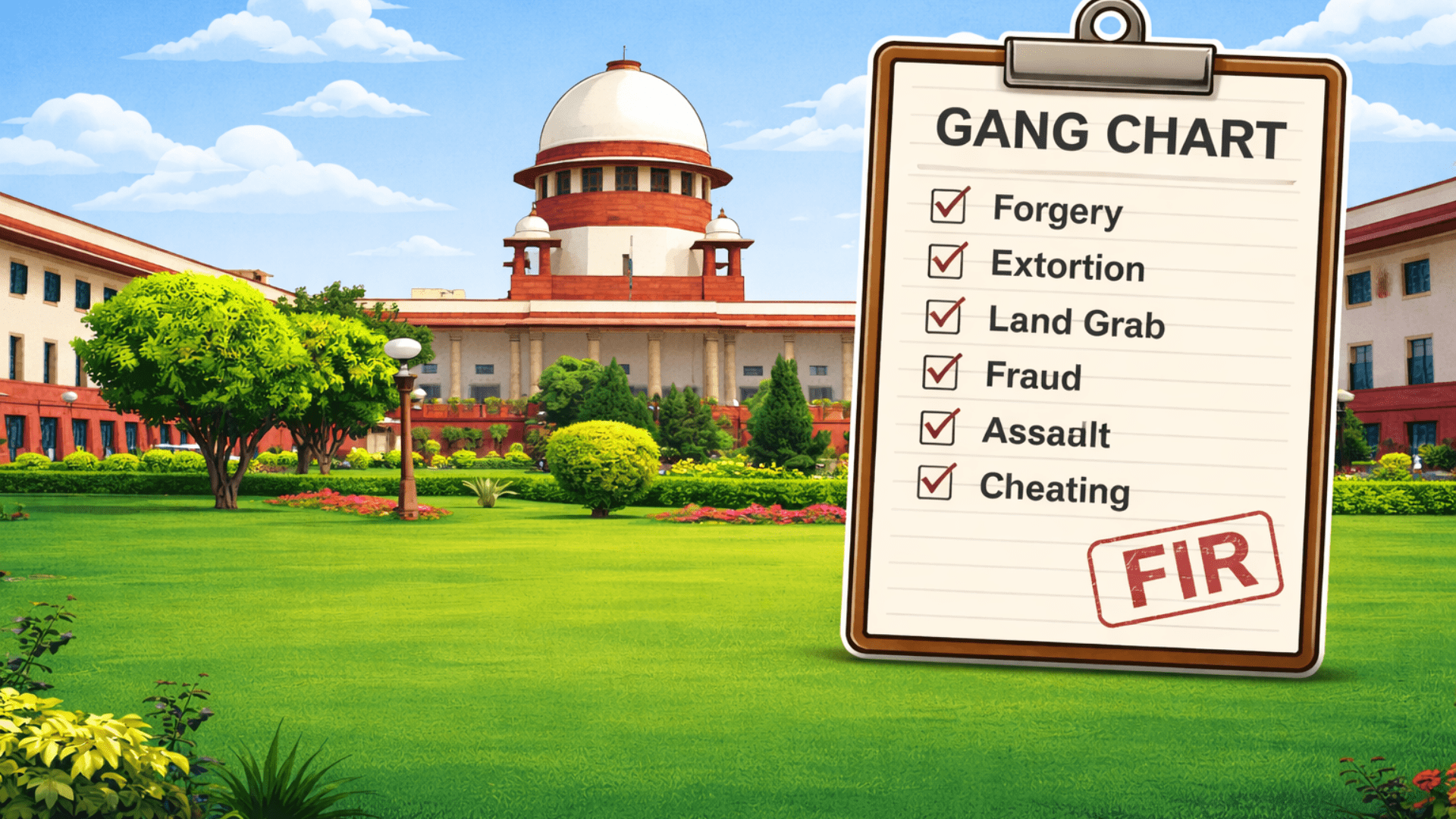
The appellant was accused of being a member of a gang that engaged in a number of criminal activities, including forgery, extortion, land grabbing, fraudulent land transactions, voluntary causing hurt and cheating.
A Gang Chart prepared by the police was the main source of information for the FIR. After reviewing the available evidence, the High Court determined that there was a prima facie case and decided not to intervene in the criminal proceedings.
The Court reiterated that,
“When a particular thing is to be done, it should be done in the manner stipulated, or not at all.”
The appellant limited his appeal to the Uttar Pradesh Gangsters and Anti-Social Activities (Prevention) Rules, 2021’s procedural flaws in the creation and adoption of the Gang Chart before the Supreme Court.
Regarding the compliance with 2021 Rules’ statutory procedure, the Court noted that,
“Undisputedly, the certified copy of the Gang Chart received from the Court to which the FIR was transmitted did not have the signatures of the various authorities including that of the Nodal Officer who is said to have initiated the recommendation. We are unable to agree with the learned Government Advocate that the Nodal Officer on preparation of the Gang Chart while forwarding it to the Additional Superintendent of Police had forwarded it to the Jurisdictional Court as well.”
Also read: https://practicinglawyer.in/supreme-court-post-retirement-disciplinary-proceedings-pension-penalty/
Although the State presented a different version of the Gang Chart, one that included signatures from various officials, the Court found no evidence of compliance with fundamental requirements. This included the obligatory joint meeting between the District Magistrate and the Superintendent of Police.
The Court further found that,
“We also make it clear that we have not said anything about the allegations raised by the Police in the offences charged in the various criminal cases as noticed in the Gang Chart, the proceedings in which will have to be taken to its logical conclusion.”
Specifically, the Court clarified that the decision was confined only to procedural irregularities and would not preclude authorities from initiating fresh action in accordance with law.
Accordingly, the Court allowed the appeals and set aside the impugned orders and quashed the FIR, holding that the Gang Chart forming the basis of the FIR did not satisfy the statutory requirements as prescribed under the 1986 Act and the 2021 Rules.
It further decided that where the legislation has significant effects on individual liberty, this kind of procedural compliance becomes even more important.
Case: Gabbar Singh alias Devendra Pratap Singh Alias Rajesh Singh vs State of U.P. and Ors.
Date of Order: 20.03.2026
Status: Allowed