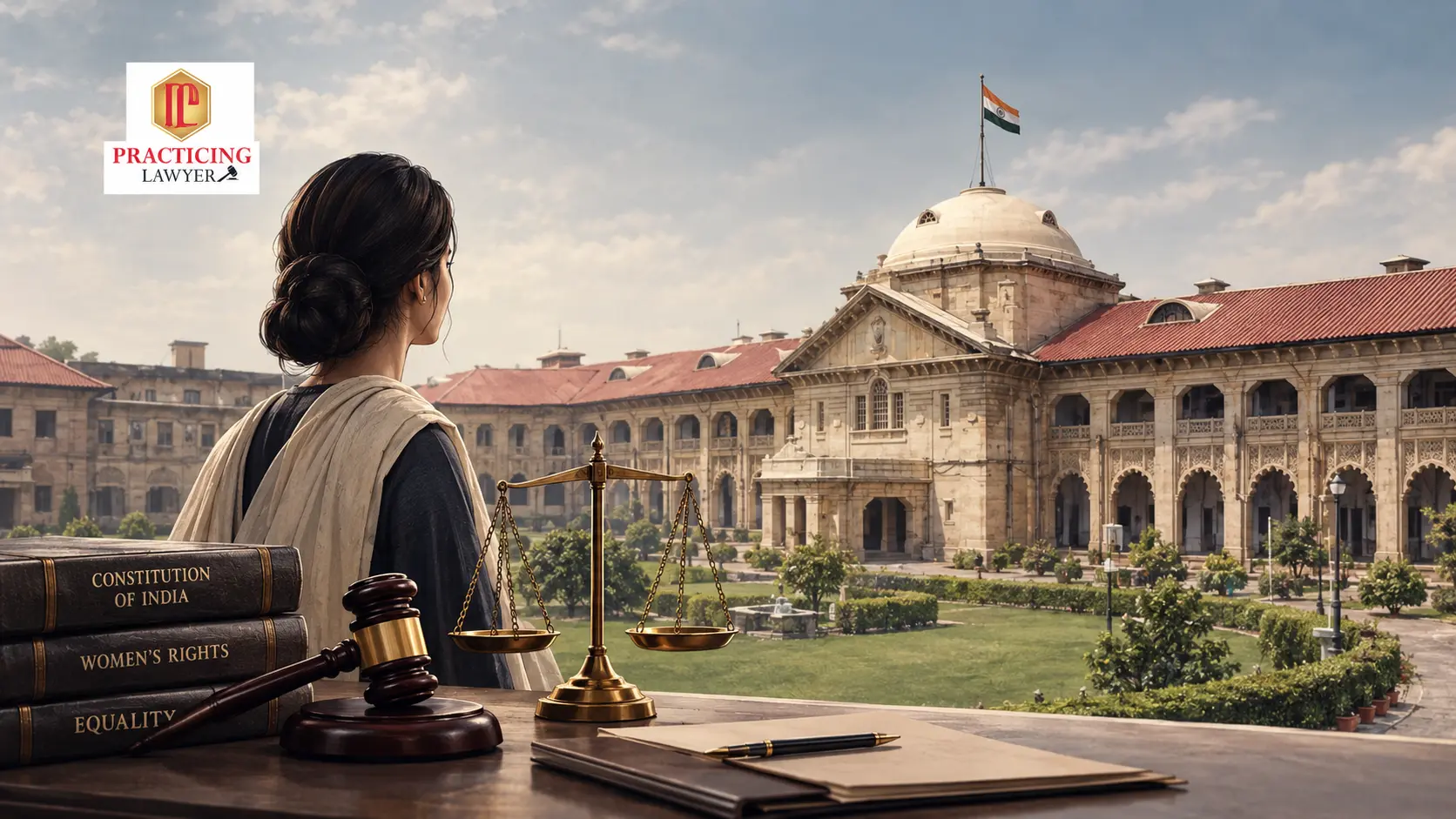
Hearing a matter related to maintenance under Section 144 of the Bharatiya Nagarik Suraksha Sanhita (BNSS), the Allahabad High Court clarified that in the absence of an explicit statutory provision, a daughter-in-law cannot be compelled to maintain her parents-in-law merely on the basis of moral obligation.
The Court observed that,
“The concept of moral obligation, howsoever compelling it may appear, cannot be enforced as a legal obligation in the absence of a statutory mandate. Maintenance under the said provision can be claimed only by persons falling within the categories specifically enumerated therein.”
Accordingly, upholding the order of the Family Court, Agra, a Single Bench of Justice Madan Pal Singh dismissed the Criminal Revision filed by Rakesh Kumar and another, wherein they had sought maintenance from their daughter-in-law.
Read also: https://practicinglawyer.in/natural-guardian-sell-minor-joint-family-property-allahabad-hc/
The Court held that although the right to claim maintenance is a statutory right, it remains limited in scope, and the Court cannot expand its ambit on its own. Under the existing legal framework, parents-in-law are not included among the categories of persons entitled to claim maintenance from a daughter-in-law. Therefore, even if a moral obligation may be perceived, the law does not impose a legal duty upon a daughter-in-law to maintain her parents-in-law.
According to the case facts, the petitioners are the aged, illiterate, and indigent parents of the deceased, who were entirely dependent for their livelihood upon their sole son, late Pravesh Kumar.
They further stated that the deceased was married to the opposite party on April 26, 2016, and he passed away on March 31, 2021. His wife is employed as a Constable in the Uttar Pradesh Police and earns a sufficient income. The petitioners claimed a moral obligation on the part of the daughter-in-law to maintain them.
On the other hand, the opposite party supported the Family Court’s order, submitting that it had been passed strictly in accordance with law.
After examining the facts of the case and the rival submissions, the Court held that a moral obligation cannot be enforced as a legal duty in the absence of statutory backing. The Court further observed that disputes relating to succession to property or service benefits fall outside the scope of summary maintenance proceedings.
The Court further noted that,
“The legislature, in its wisdom, has not included parents- in-law within the ambit of the said provision. In other words, it is not the scheme of the legislature to fasten liability of maintenance upon a daughter-in-law towards her parents-in-law under the said provision.”
Finding no illegality or infirmity in the order passed by the Family Court, the High Court dismissed the criminal revision petition.
Case: Rakesh Kumar and Another vs State of U.P. and Another
Case No: Criminal Revision No. – 6502 of 2025
Date of Order: 04.02.2026
Status: Dismissed