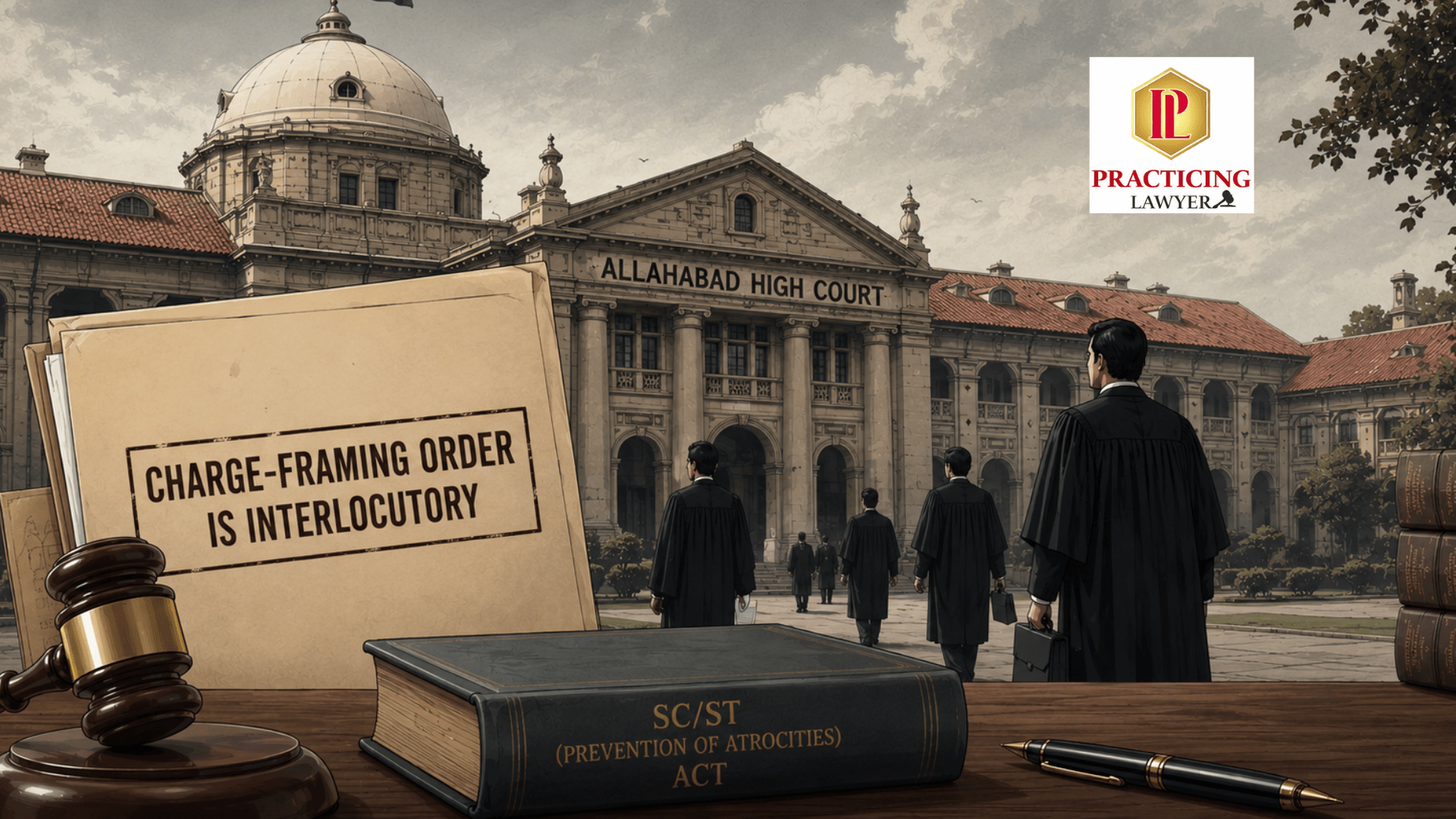
The Allahabad High Court has ruled that an order framing charges under the SC/ST Act is purely interlocutory in nature and, therefore, cannot be challenged through an appeal under Section 14-A(1) of the Scheduled Castes and Scheduled Tribes (Prevention of Atrocities) Act, 1989.
Emphasizing that a criminal trial effectively commences once charges are framed, the Court observed that such an order neither finally determines the rights of parties nor terminates proceedings and hence falls squarely within the ambit of an “interlocutory order.”
The judgment was delivered by Single Bench of Justice Madan Pal Singh while dismissing Criminal Appeal No. 1753 of 2026 filed by Rajan Chaurasia alias Rajendra and three others.
The appeal challenged the order dated September 15, 2025 passed by the Special Judge (SC/ST Act), Deoria, whereby charges had been framed against the appellants in Special Trial, titled Badami Devi vs. Rajan Chaurasia & Others.
According to the case records, the proceedings arose from an FIR lodged at Khukhundu Police Station in Deoria district under Sections 427, 504 and 506 of the IPC along with Sections 3(1)(da) and 3(1)(dha) of the SC/ST Act.
Read also: https://practicinglawyer.in/allahabad-hc-protects-couple-despite-disputed-nikah/
The appellants had approached the High Court seeking quashing of the charge-framing order, contending that such an order could not be treated as interlocutory and was therefore appealable under Section 14-A of the Act.
Rejecting the submission, the Court undertook an extensive examination of precedents rendered by the Supreme Court, including Ratilal Bhanji Mithani vs. State of Maharashtra reported in (1979) 2 SCC 179, Bharat Parikh vs. CBI & Another reported in (2008) 10 SCC 109, State through CBI New Delhi vs. Jitendra Kumar Singh reported in (2014) 11 SCC 724, Hardeep Singh vs. State of Punjab reported in (2014) 3 SCC 92, and V.C. Shukla vs. State through CBI reported in 1980 Supp SCC 92.
Relying upon the above decisions, the Bench reiterated that once charges are framed, the stage of discharge comes to an end and the court thereafter can only proceed toward acquittal or conviction.
The Court observed that an interlocutory order is one passed during the pendency of proceedings which does not finally adjudicate the rights and liabilities of the parties.
It held that framing of a charge merely signifies the commencement of the trial and calls upon the accused to answer the allegations leveled against him.
Since the proceedings continue thereafter until the culmination of the trial, such an order cannot be regarded as final.
The Bench further noted that Section 14-A(1) of the SC/ST Act expressly bars appeals against interlocutory orders.
The Court ruled that,
“Perusal of the Section 14-A (1) specifically reflects that an appeal shall lie, from any judgment, sentence or order, not being an interlocutory order, of a Special Court or an Exclusive Special Court, to the High Court both on facts and on law…”
In a significant observation, the Court stated that even if, for the sake of argument, the order framing charges were presumed to be appealable, the appellate court still could not direct the trial court to discharge the accused or reconsider framing of charges, since the trial court itself lacks jurisdiction to discharge an accused after charges have been framed.
The Court said the settled legal position leaves only two possible outcomes after framing of charges – conviction or acquittal.
The judgment also referred to a recent decision of the Himachal Pradesh High Court in Lagnesh Verma vs. State of H.P. & Others reported in 2026 SCC OnLine HP 1038, where it was similarly held that appeals against orders framing charges are not maintainable, though the aggrieved party may pursue revisional or inherent jurisdiction remedies where permissible in law.
Concluding that the impugned order was interlocutory in nature and therefore insulated from appeal under Section 14-A(1) of the SC/ST Act, the High Court upheld the preliminary objection regarding maintainability and dismissed the instant criminal appeal.
Case: Rajan Chaurasia @ Rajendra And 3 Others vs State of U.P. and Another
Case No: Criminal Appeal No. – 1753 of 2026
Date of Order: 14.05.2026
Status: Dismissed