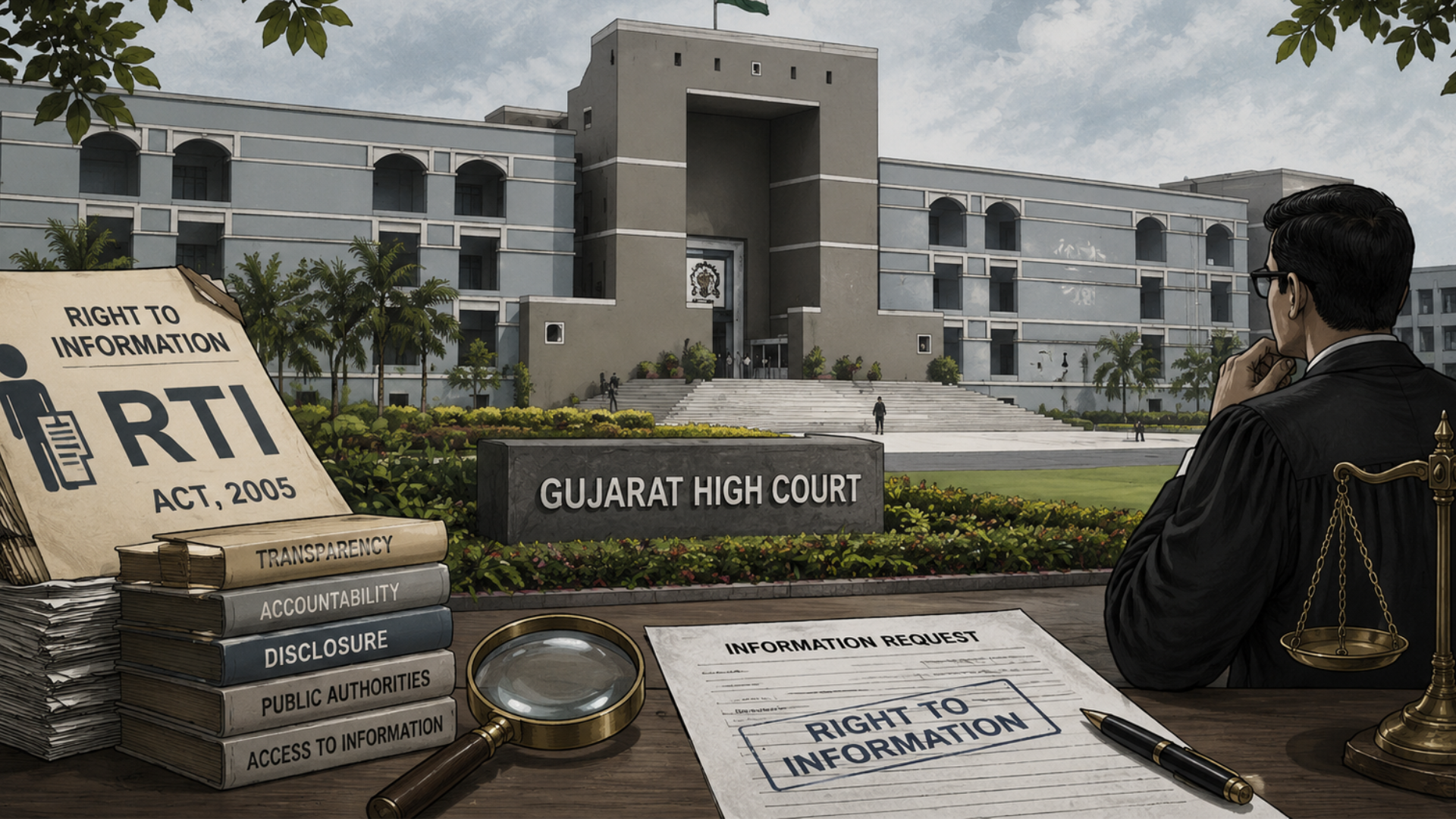
The Gujarat High Court has ruled that proceedings under the Right to Information Act cannot be transformed into a forum for adjudicating disputes over the “correctness” of information supplied by public authorities.
Dismissing a petition challenging alleged incomplete replies furnished under the RTI Act, the Court observed that,
“the proceedings under the RTI Act cannot be converted into proceedings for adjudication of disputes as to the correctness of the information furnished.”
The Court further held that once accessible records and documents are supplied, the obligation of the Public Information Officer stands discharged under the law.
The order was passed by Justice Hemant M. Prachchhak in a petition filed by Himanshu Parsottambhai Parmar against the State of Gujarat and other authorities.
The petitioner, appearing party-in-person before the Court, had challenged a common order dated September 15, 2025 passed by the Chief Gujarat Information Commission.
Read also: https://practicinglawyer.in/allahabad-hc-maintenance-under-crpc-is-a-right-not-charity/
The case began after the petitioner filed many RTI applications questioning the process adopted for temporary teaching appointments from Faculty of Commerce, The Maharaja Sayajirao University of Baroda.
Through these applications, he sought detailed information on the implementation of reservation policy, category-wise vacancies, names of selected and rejected candidates, and whether SC/ST representatives were included in the selection committees.
The petitioner alleged that the University authorities had furnished arbitrary and incomplete information without supporting office records and had failed to comply with the State’s reservation policy in temporary appointments.
Read also: https://practicinglawyer.in/allahabad-hc-sc-st-charge-order-not-appealable/
According to the case record, the petitioner had repeatedly sought information concerning temporary assistant professor appointments for the academic year 2024-25.
He also questioned the implementation of reservation norms in temporary recruitment by the University and other educational authorities in Gujarat.
The Gujarat Information Commission, while disposing of the appeal and complaint, directed the concerned Public Information Officer to provide the relevant category-wise details, selection lists, waiting lists, and cut-off marks within ten days free of cost through speed post.
Before the High Court, the petitioner argued that the Information Commission’s order was incomplete and contrary to clause 15 of the guidelines issued by the Ministry of Personnel and Public Grievances and Education Department.
He further contended that the University had not uploaded the list of selected candidates and had violated a circular issued by the Education Department, Gandhinagar on May 3, 2022.
However, the High Court noted that the authorities had already supplied the information available with them in compliance with the Commission’s directions.
The Court also took note of the respondents’ submission that the petitioner had filed more than 25 RTI applications one after another on similar issues.
While examining the legal position, the Court relied extensively on the decision of the Delhi High Court in Narendra Tyagi vs Assistant Director (CPIO) in LPA 764/2023 & CM Application No.60986 – 60987 of 2023 wherein it was held that RTI forums are not meant to adjudicate disputes regarding the correctness or adequacy of information supplied.
Referring to the Delhi High Court judgment, the Court reiterated that the RTI Act merely obliges authorities to furnish information available on record and does not empower them to render opinions or settle factual controversies.
The Court further referred to Section 2(f) of the RTI Act defining “information” and observed that the statutory duty of a Public Information Officer ends once all accessible documents, records, memos, e-mails, press releases, circulars, orders, logbooks, and materials available with the authority are furnished.
Rejecting the petitioner’s insistence on supply of original documents, the Court observed that such a demand falls outside the purview of the RTI mechanism.
The Court also reproduced an observation made by the Information Commission expressing an expectation that the complainant would “refrain from filing a special application under the Right to Information Act in this regard” in future.
Concluding that no illegality or perversity could be found in the orders passed by the Information Commission or the authorities concerned, the High Court held that the petition was devoid of merit.
Accordingly, the Special Civil Application was dismissed and the notice discharged without any order as to costs.
Case: Himanshu Parsottambhai Parmar vs State of Gujarat & Ors.
Case No: R/Special Civil Application No. 15120 of 2025
Date of Order: 05.05.2026
Status: Dismissed