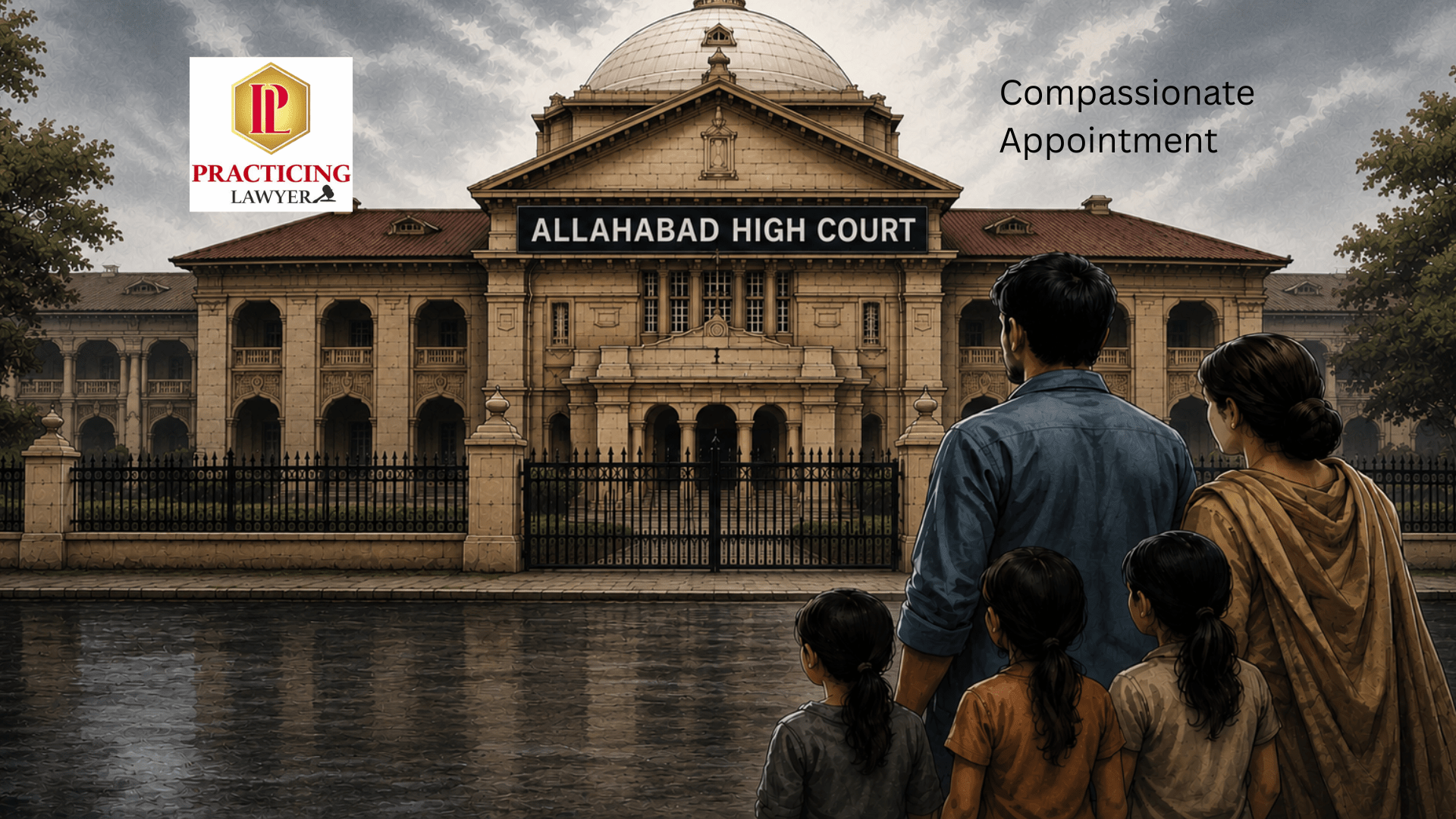
The Allahabad High Court has reiterated that compassionate appointment cannot be claimed as a perpetual right and is meant solely to provide immediate financial relief to the family of a deceased government employee facing sudden distress.
Dismissing a plea seeking appointment more than eleven years after the employee’s death, the Court observed that, “Compassionate appointment is not a regular appointment but an exception. Any application by the eligible dependent of the government servant ought to have been filed within a reasonable period as provided in Rule 5.” and that, “Right to appoint on compassionate ground is not available in perpetuity.”
The Court further underscored that permitting such delayed claims would defeat the very object behind the scheme, which is intended only to help a bereaved family tide over an immediate financial crisis.
The order was passed by Justice Anish Kumar Gupta while dismissing a writ petition filed by Balesh Kumar.
The petitioner had challenged the administrative orders dated December 19 and December 24, 2016, through which his claim for compassionate appointment under the Uttar Pradesh Recruitment of Dependants of Government Servants Dying in Harness Rules, 1974, had been rejected by the High Court administration.
Read also: https://practicinglawyer.in/allahabad-hc-questions-arms-licences-accused/
According to the facts recorded by the Court, the petitioner’s father was employed as a Class-IV employee in the Moradabad judgeship and died in harness on January 1, 2003.
At the time of his death, the family consisted of his widow, one minor son, the present petitioner, and four minor daughters.
The petitioner was only around ten years old then. Shortly after the employee’s demise, the petitioner’s mother applied for compassionate appointment on January 10, 2003, within the prescribed time limit.
However, the process could not be completed as she failed to fulfill the required formalities.
Read also: https://practicinglawyer.in/allahabad-hc-remand-non-production-valid/
The petitioner later contended that his mother had met with an accident and lost her eyesight, rendering her completely blind and incapable of pursuing the application further.
After attaining majority and completing his intermediate education, the petitioner moved an application for compassionate appointment on July 16, 2014, claiming that he had become the sole support of the family.
His plea, however, was rejected on the ground of an inordinate delay of over eleven years from the date of death of the employee.
Before the Court, counsel for the petitioner argued that the delay was neither deliberate nor negligent but was caused by exceptional family circumstances, including the mother’s blindness and the responsibility of maintaining four sisters.
It was submitted that since the mother had initially applied within time, the petitioner’s subsequent claim deserved sympathetic consideration.
Rejecting the submission, the High Court held that Rule 5 of the 1974 Rules clearly mandates that an application for compassionate appointment must ordinarily be filed within five years from the date of death of the deceased employee.
The Court held that while the State may relax the limitation period in rare and exceptional circumstances, such relaxation cannot extend endlessly.
Since the petitioner was a minor at the time of the government servant’s death and became eligible only after more than ten years, the claim had lost its immediacy and could not be revived.
Relying extensively on precedents of the Supreme Court, including N.C. Santhosh vs. State of Karnataka, (2020) 7 SCC 617, State of Himachal Pradesh and Another vs. Shashi Kumar, (2019) 3 SCC 653, and Fertilizers and Chemical Travancore ltd. & Ors. vs. Anusree K.M., 2022 SCC OnLine SC 1331, the Court reiterated that compassionate appointment is not an alternative mode of public recruitment.
Quoting settled principles, the Court observed that public employment must ordinarily be governed by Articles 14 and 16 of the Constitution and granted through open competition, while compassionate appointment survives only as a narrowly tailored humanitarian exception.
The Court also referred to the Supreme Court’s observation that granting compassionate appointment after decades would run contrary to the very rationale of the scheme.
It observed that the purpose is “…..to enable the family to tide over the sudden crisis” and “not to give such family a post much less a post held by the deceased.”
Finding no illegality in the rejection order passed by the authorities, the High Court ultimately dismissed the writ petition, holding that the petitioner’s claim was hopelessly barred by delay and contrary to the governing statutory framework.
Case: Balesh Kumar vs Registrar Hon Ble High Court And Anr.
Case No: Writ – A No. – 17441 of 2017
Date of Order: 20.05.2026
Status: Dismissed