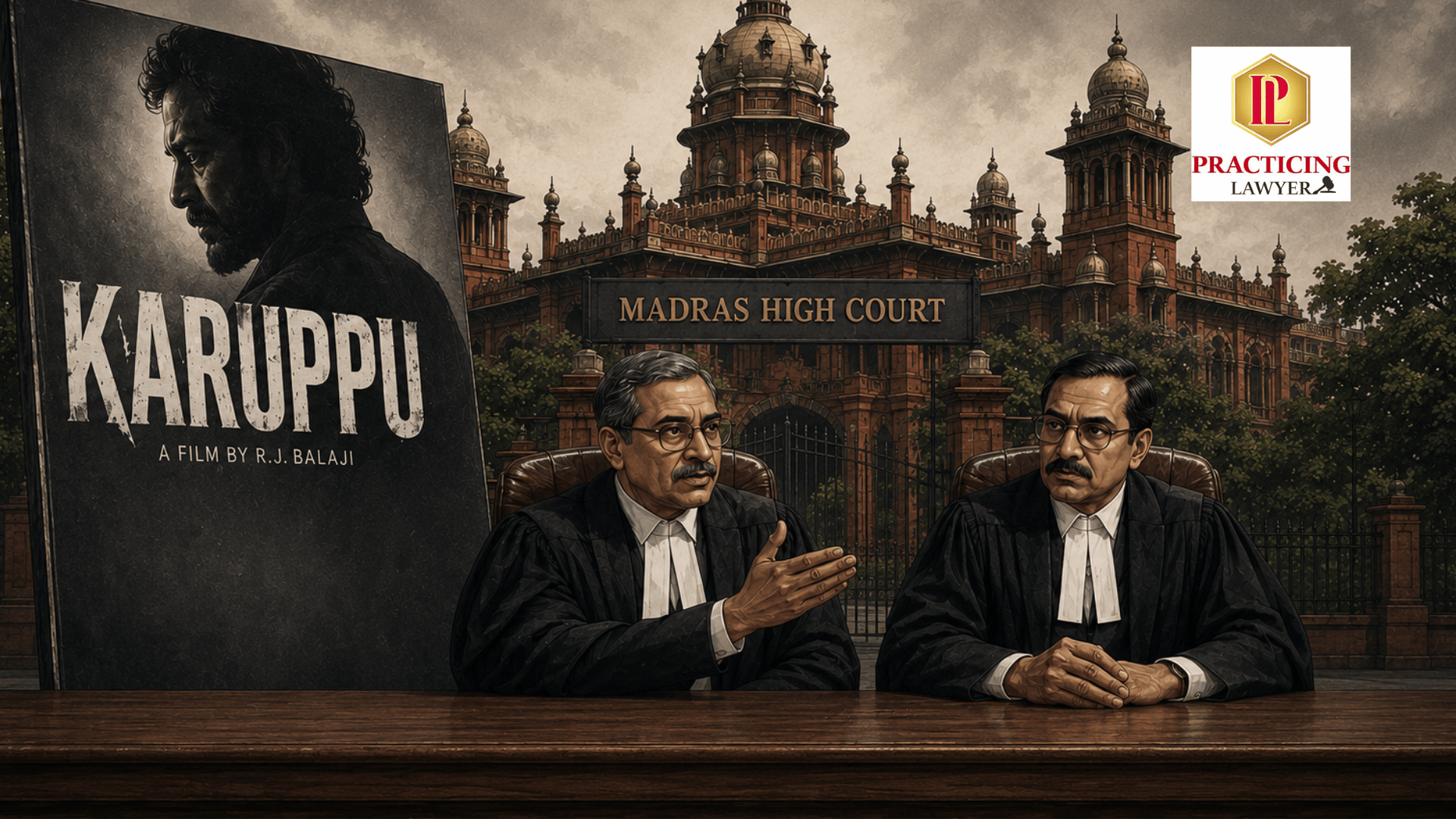
The Madras High Court has refused to halt the screening of Tamil film ”Karuppu,” strongly backing artistic freedom and observing that ”Judges need not be treated as holy cows. Justice is not a cloistered virtue; she must be allowed to suffer the scrutiny and respectful even though outspoken comments of ordinary men (Lord Atkin)…”
Dismissing a plea seeking a ban on the movie, the Court remarked that ”Some feign outrage and pretend to take offence on innocuous issues. The case on hand is a textbook example.”
The Bench further underlined that ”Judges are not above criticism” and that freedom of expression protects “not only the words we like but also those that we hate.”
The order was passed by a Division Bench comprising Justice G.R. Swaminathan and Justice V. Lakshminarayanan in a writ petition filed by Chennai-based advocate R.S. Tamilvendan against the State of Tamil Nadu, the Central Board of Film Certification (CBFC), the film’s producer Dream Warrior Pictures, Director-actor R.J. Balaji, actor Suriya and actress Trisha.
The petitioner sought directions to ban or regulate the screening of “Karuppu” in theaters and on OTT platforms, alleging that the movie portrayed courts and judicial officers in a derogatory manner.
At the very outset, the Bench took note of what it described as the petitioner’s exaggerated sense of outrage. In unusually sharp remarks, the Court observed that the representation submitted by the petitioner in Tamil was riddled with spelling and grammatical mistakes, adding that the petition itself “deserved a dismissal for having sent such a shoddy representation.”
However, the Court proceeded to examine the matter on merits before ultimately rejecting the plea.
The Bench noted that the film revolves around a fictional court situated in a place called “Seven Wells”, where a corrupt presiding officer and an unethical advocate wields immense power over the functioning of the Court are depicted.
Read also: https://practicinglawyer.in/allahabad-hc-rejects-delayed-compassionate-appointment/
Refusing to treat such portrayal as contemptuous, the Court candidly acknowledged that corruption in the judiciary cannot be denied altogether.
Referring to past judicial observations on judicial corruption, the Bench said that while sweeping allegations against the entire institution cannot be endorsed, “we do know and have come across instances of judicial corruption.”
At the same time, the Court emphasized that cinema, by its very nature, thrives on exaggeration and dramatic effect.
“Everything is melodramatic in Tamil cinema,” the Bench observed, further adding that, “In any event, the artist is entitled to present in his own way. This is what is called as artistic licence.”
Relying on several Supreme Court judgments safeguarding free speech and artistic expression, the Court reiterated that creative works cannot be tested with the same standards applicable to factual or documentary presentations.
Read also: https://practicinglawyer.in/allahabad-hc-questions-arms-licences-accused/
Drawing parallels with political cartoons and caricatures, the Bench observed that artistic works often employ ridicule, satire and distortion to make a point.
“The manner of presentation and the content of presentation must be left to the creator,” the Court said, adding that, “So long as the author does not venture into forbidden territories, the creative spirit must be respected.”
The Court further held that once the CBFC had granted certification to the movie, the writ court could not substitute its own opinion merely because a section of viewers felt offended.
Referring to the Supreme Court’s ruling in Prakash Jha Productions vs. Union of India, (2011) 8 SCC 372, the Bench observed that courts ordinarily should not interfere with the exhibition of films already cleared by the statutory expert body.
Rejecting the argument that the movie amounted to criminal contempt, the Bench clarified that the Section 2(c) of the Contempt of Courts Act, 1971 would apply only where an actual court is scandalized or its authority lowered.
Since “Seven Wells Court” shown in the movie was entirely fictional, the penal provisions relating to contempt were held inapplicable.
“When a person presiding over an imaginary Court is portrayed as corrupt, it would not attract the penal provisions contained in the Contempt of Courts Act, 1971. We may finally note that the director has not portrayed the entire judicial system as corrupt.” the Bench ruled.
The Court also made broader observations on democracy and judicial accountability, stressing that criticism of courts, even if harsh or unpleasant, cannot automatically invite censorship.
Quoting celebrated judicial precedents from India and abroad, the Bench observed that public debate in a democracy must remain “uninhibited, robust and wide open.”
Holding that no ground existed to prohibit the screening of the movie, the High Court dismissed the writ petition and declined to issue any directions against the film.
Case: R.S.Tamilvendan vs Secretary to the State of Tamil Nadu and Others
Case No: WP No. 20286 of 2026 and WMP No. 21743 of 2026
Date of Order: 21.05.2026
Status: Dismissed