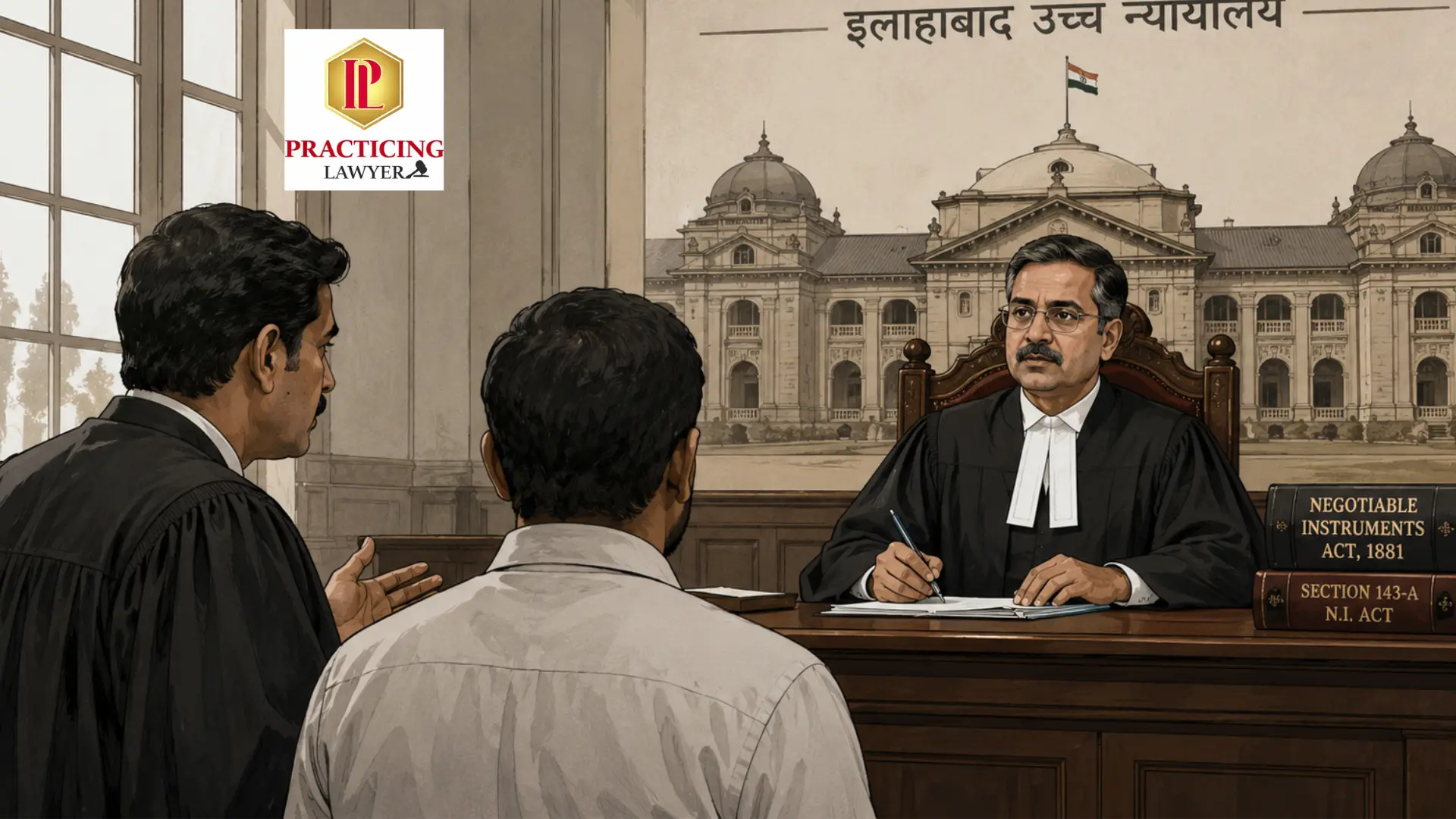
The Allahabad High Court has observed that although the power to award interim compensation under Section 143-A of the Negotiable Instruments Act is discretionary in nature, once the complaint prima facie discloses a legally enforceable liability and issuance of cheques, a mere allegation by the accused that the cheques were misused cannot, by itself, be a sufficient ground to refuse such compensation.
The Court emphasized that at the preliminary stage, it is not required to undertake a detailed appreciation of evidence or conduct a “mini-trial.”
The ruling was delivered by Justice Jai Krishna Upadhyay while dismissing an application filed by Rahul Yadav under Section 528 of the Bharatiya Nagarik Suraksha Sanhita (BNSS).
The petitioner had challenged the revisional order passed by the Sessions Judge, Gautam Buddh Nagar, as well as the order of the Special Court under the N.I. Act, Gautam Buddh Nagar, which had allowed the complainant’s application for interim compensation under Section 143-A of the Act.
According to the facts of the case, Rahul Yadav, who was engaged in the real estate business, allegedly owed Rs. 10 lakh to the complainant.
To discharge the liability, he issued three cheques. Upon presentation, the cheques were dishonoured with the remarks “Funds Insufficient” and “Account Inoperative.”
The complainant thereafter moved an application under Section 143-A seeking interim relief.
Accepting the plea, the Trial Court vide order dated 20.11.2025, directed the accused to deposit 20 percent of the cheque amount, i.e., Rs. 2 lakh, within two months.
While examining the legality of the order, the High Court referred to the Supreme Court’s decision in Rakesh Ranjan Shrivastava vs. State of Jharkhand, (2024) 4 SCC 419 and noted that “the exercise of power under sub-section (1) of Section 143-A is discretionary. The provision is directory and not mandatory.”
The Court also reiterated that “only if the complainant makes out a prima facie case, a direction can be issued to pay interim compensation,” and that “if the defence of the accused is found to be prima facie plausible,” the court may refuse such relief.
Explaining the scope of the Latin term “prima facie,” the Court observed that it means an assessment made “at first sight” or on a “first impression.”
It clarified that the standard does not require proof beyond reasonable doubt but merely ensures that the claim possesses sufficient legal merit to proceed further.
Relying on settled precedent, the Court stated that while a judge must apply judicial mind to ascertain whether a genuine offence is disclosed, he must refrain from weighing the deeper merits of the case, appreciating disputed factual defences, or conducting a “mini-trial” at the threshold stage.
Applying these principles to the facts of the case, the Court found that the disputed cheques admittedly belonged to the accused and that his signatures on them were not in dispute. The accused had already been summoned, and notice under Section 251 Cr.P.C. remained pending for a considerable time.
The Court further noted that the accused’s bank account had already become inoperative and lacked sufficient funds, rendering his defence of cheque misuse inherently improbable.
It observed that “the defence sought to be raised by the accused regarding the alleged misuse of cheques is essentially a matter of trial and can only be adjudicated upon after evidence is led by the parties.”
The Court added that “merely because the accused has taken a defence that the cheques were misused does not automatically exclude the complainant from seeking interim compensation.”
Rejecting the challenge to the quantum of compensation, the Court held that the trial court had duly considered the nature of the allegations, the pendency of the complaint, and the admitted signatures on the cheques before awarding the maximum permissible compensation of 20 percent.
Concluding that the impugned orders suffered from neither perversity nor any jurisdictional infirmity, the Court held that no case for interference was made out and dismissed the application.
Case: Rahul Yadav vs State of U.P. and Another
Case No: Application u/s 528 BNSS No. – 22924 of 2026
Date of Order: 02.06.2026
Status: Dismissed