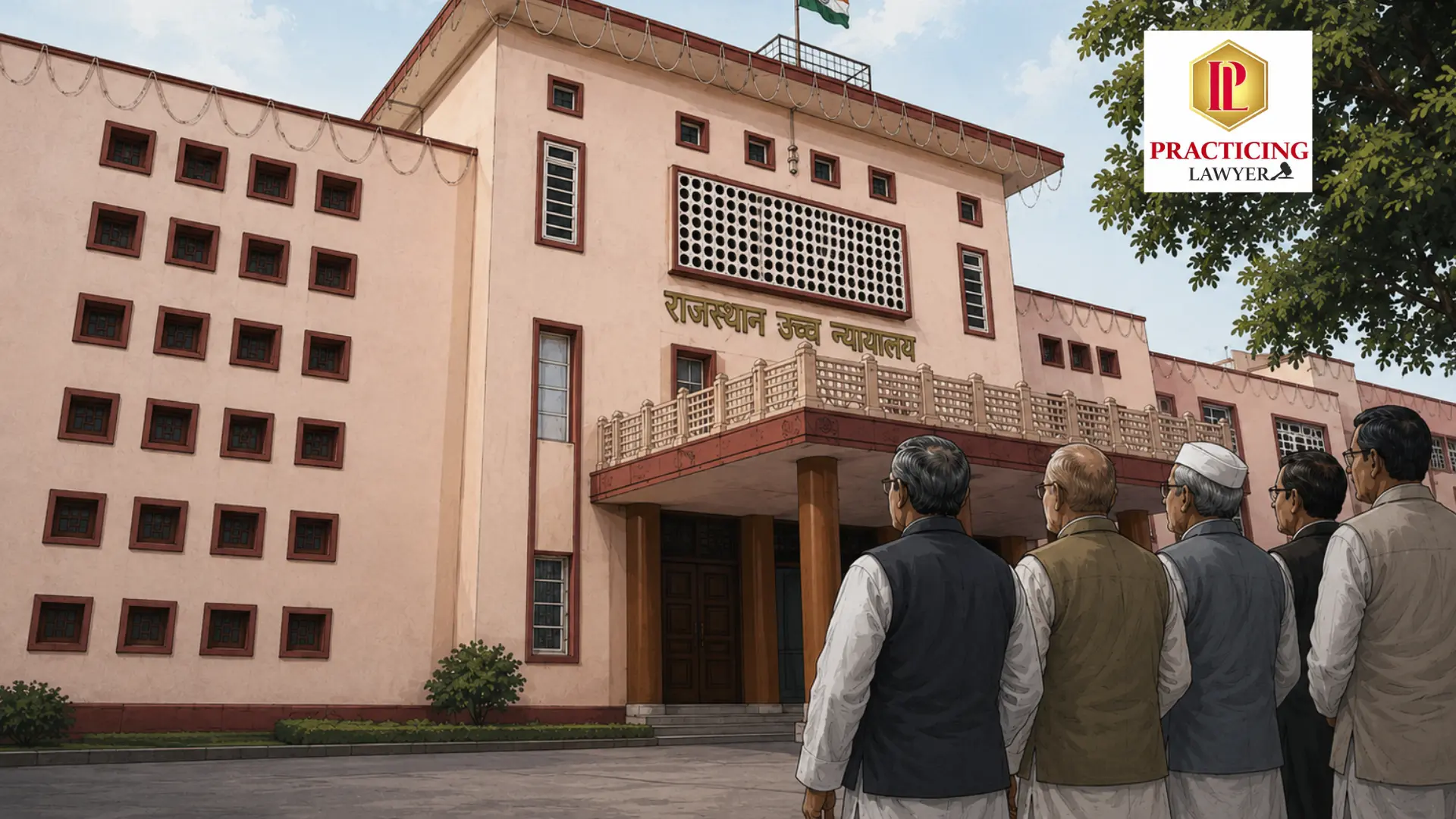
The Rajasthan High Court (Jaipur Bench) has refused to strike down the law granting pension to former Members of the Legislative Assembly, holding that the Constitution does not prohibit such a benefit merely because Article 195 mentions only “salaries and allowances.”
Dismissing a public interest litigation, the Court observed that “the absence of an express constitutional provision providing pension to legislators does not, by itself, denude the competent Legislature of its authority to enact such a law.”
It also rejected the argument that the Constitution contains an implied ban on such legislation, observing that “such a prohibition, however cannot be inferred in the absence of any express constitutional limitation, particularly when the Constitution itself recognizes “State pensions” as a distinct legislative field under Entry 42 of List II of the Seventh Schedule.”
The judgment was delivered by a Division Bench of Justice Dr. Pushpendra Singh Bhati and Justice Vinit Kumar Mathur on a petition filed by Jaipur resident Milap Chand Dandia.
The petitioner had questioned the constitutional validity of the Rajasthan Legislative Assembly (Officers and Members Salary, Emoluments and Pension) Act, 1956, along with later amendments extending additional benefits to former legislators.
He had sought a declaration that the pension provisions were unconstitutional, illegal, and void and also direction to stop further payments and recovery of the pension already disbursed.
The petitioner contended that Article 195 authorises the State Legislature to determine only the salaries and allowances of MLAs and makes no reference to pension.
Read also: Arrest Without BNSS Compliance Set Aside, Orders for Release of the accused: Allahabad High Court
Relying on Article 366(17), which separately defines the expression “pension,” it was argued that pension is an independent constitutional concept and could not be extended to legislators through ordinary legislation.
It was further submitted that legislators do not retire from service like government employees and, therefore, pension cannot be justified on the same footing.
The High Court, however, found no merit in these submissions. It noted that the issue had already been examined by the Supreme Court in Lok Prahari through its General Secretary S.N. Shukla & Anr. vs. Union of India through its Secretary and Ors. reported in (2018) 16 SCC 696, where a similar challenge to pension payable to Members of Parliament had been rejected.
Referring to that decision, the Bench observed that the Constitution does not compel payment of pension to constitutional functionaries, but it equally does not prevent the competent legislature from providing such a benefit through law.
The Court also pointed out that the Supreme Court had clarified that pension is not a concept restricted to retired government employees.
It referred to the Apex Court’s observation that several forms of pension, including old-age, widow, and disability pensions, exist independently of any employer-employee relationship.
Therefore, the argument that only retired public servants can receive pension was held to be legally unsustainable.
While examining the constitutional scheme, the Bench observed that the legal framework governing Members of Parliament and Members of Legislative Assemblies is broadly similar in matters relating to financial benefits.
It held that once Parliament’s competence to provide pension to former MPs has been recognised, the State Legislature is equally empowered to legislate on “State pensions” under Entry 42 of List II read with Article 246(3) of the Constitution.
The mere fact that Article 195 refers to salaries and allowances does not take away that legislative power.
The Court also took note of earlier decisions of the Allahabad, Gujarat and Madhya Pradesh High Courts, all of which had upheld laws granting pension to former legislators.
According to the Bench, these judgments consistently recognise that there is no constitutional embargo on such legislation and that the power to enact laws relating to State pensions falls squarely within the legislative competence of the State.
The Bench ruled that,
“Once the competence of Parliament to enact laws providing pensionary benefits to Members of Parliament has been recognized, and the State Legislature derives legislative competence in relation to “State pensions” under Entry 42 of List II read with Article 246(3) of the Constitution of India, the challenge raised to the impugned enactment cannot be sustained merely on the ground that Article 195 expressly refers only to “salaries and allowances”.
Reiterating the limits of judicial review, the Court observed that policy choices made by the Legislature cannot be interfered with unless they violate constitutional provisions or are beyond legislative competence.
The Bench said there was no reason to interfere with the legislation as it fell within the Legislature’s constitutional powers and did not violate any provision of the Constitution.
Holding that the petitioner had failed to make out a case for judicial intervention, the Court dismissed the writ petition along with all pending applications.
Case: Milap Chand Dandia vs State Of Rajasthan through Chief Secretary of the Government of Rajasthan
Case No: D.B. Civil Writ Petition No. 19134/2022
Date of Order: 07.05.2026
Status: Dismissed