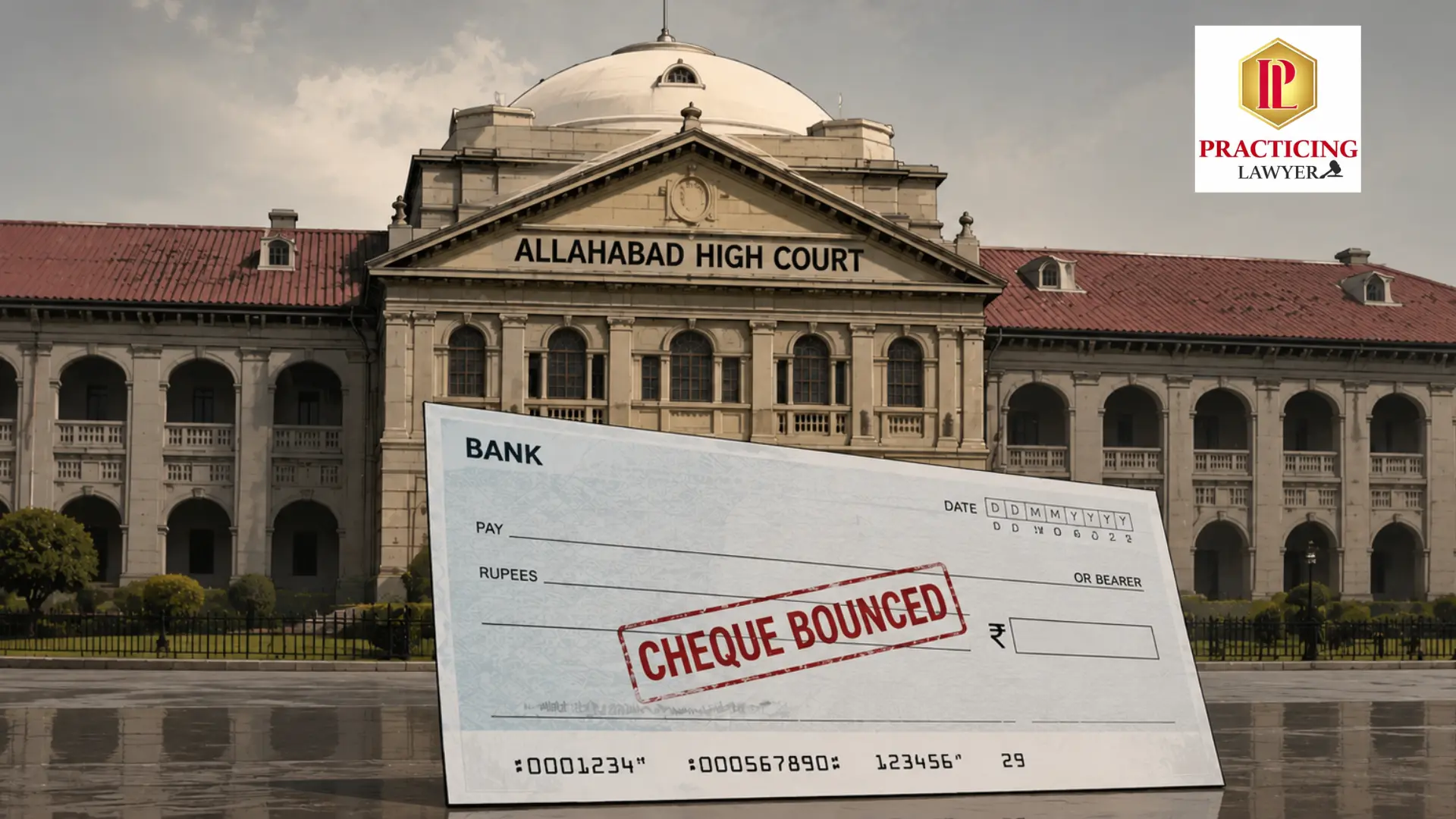
Holding that criminal law cannot be used to settle what is essentially a financial dispute, the Allahabad High Court has ruled that dishonour of cheques arising out of monetary transactions must ordinarily be addressed under Section 138 of the Negotiable Instruments Act.
The Court observed that a purely economic or commercial dispute cannot be dressed up as a criminal prosecution.
It also noted that the prosecutrix was a highly educated woman pursuing a Ph.D. and was fully conscious of the implications of entering into a relationship.
These observations were made by Justice Santosh Rai while allowing two criminal appeals filed by Saurabh Pal Singh and discharging him from all charges.
The case arose from an FIR lodged at Shivkuti Police Station, Prayagraj, under various sections of the Indian Penal Code and SC/ST (Prevention of Atrocities) Act.
According to the prosecution, the informant and the appellant had known each other for years. The informant, a Scheduled Caste woman and Ph.D. scholar at the University of Allahabad, alleged that she had given nearly ₹15 lakh to the appellant to establish a restaurant business and that two cheques of ₹5 lakh each issued by him were later bounced.
The informant also alleged that the appellant and his family members intentionally insulted her by using caste-indicative abusive words and refused to return her money. Later on, she lodged the FIR against the appellant.
During investigation, the investigating officer submitted a chargesheet against the appellant under the aforesaid sections.
The appellant, thereafter, filed a discharge application under Section 227 Cr.P.C., which was rejected by Special Judge (SC/ST Act). Thereafter, the appellant had filed Criminal Appeal No.769 of 2025.
During the pendency of the criminal appeal, the trial court had framed charges.
Aggrieved thereby, the appellant challenged the discharge application by filing the instant criminal appeal before the High Court.
Examining the record, the High Court found that the financial transactions formed the core of the dispute. It observed that the law already provides a specific remedy where cheques are bounced and that criminal proceedings should not be invoked merely because a monetary transaction has gone wrong.
The Court reiterated that every violation of promise does not amount to cheating, nor can a failed promise automatically be treated as one that was false from the very beginning.
On the allegation of rape, the Court held that the materials collected during investigation did not disclose a prima facie case.
It noted that the statement recorded under Section 164 Cr.P.C. did not indicate that the physical relationship was induced by a promise of marriage which the appellant never intended to honour from its inception.
The Court also found it significant that neither the FIR nor the statements on record specified the date, time or place of the alleged incident.
The judgment further records that the complainant herself admitted there was no romantic relationship between the parties, although they remained acquainted for several years.
Referring to the overall circumstances, the Court observed that she was well educated, pursuing doctoral studies, and fully aware of the consequences of entering into such a relationship.
These circumstances, the Court said, were relevant while assessing whether the allegations disclosed the ingredients of the offences alleged.
The Bench also found no material to support the offences of cheating, criminal breach of trust or the charge under Section 3(2)(v) of the SC/ST (Prevention of Atrocities) Act.
It reiterated that the mere fact that the complainant belongs to a Scheduled Caste or Scheduled tribe is not enough to attract the provision unless there is prima facie evidence that the alleged offence was committed because of her caste identity.
Since no such evidence was available, the provision was held to be inapplicable.
Concluding that the prosecution material, even if accepted at face value, did not justify the continuation of criminal proceedings, the High Court quashed the orders refusing discharge and framing charges.
Appellant was consequently discharged from the offences under Sections 376, 420, 406, 504, and 506 IPC and Section 3(2)(v) of the SC/ST (Prevention of Atrocities) Act.
Case: Saurabh Pal Singh vs State of U.P. and another
Case No: Criminal Appeal No. – 769 of 2025 (Along with Connected Criminal Appeal)
Date of Order: 06.07.2026
Status: Allowed