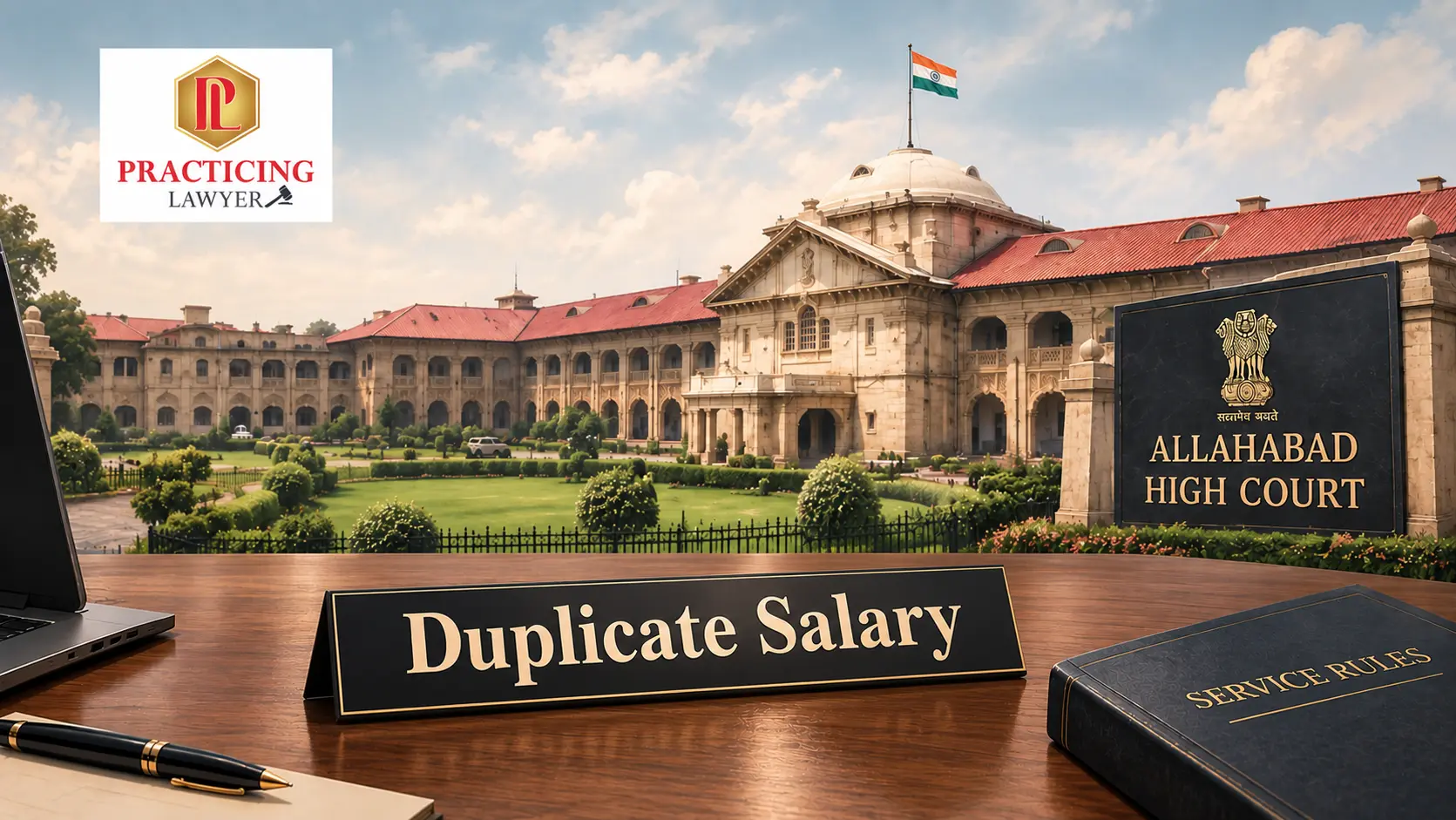
The Allahabad High Court has held that an employee cannot claim an indefeasible right to retain duplicate remuneration drawn simultaneously from two government departments when such receipt is contrary to the governing service conditions.
However, the State can recover only the amount demonstrably attributable to such impermissible simultaneous drawal and cannot indiscriminately recover the entire salary paid for services actually rendered.
The Court observed, “The State cannot, under the guise of recovery, seek restitution of remuneration which demonstrably represents payment for services actually rendered in a post during a period in which the petitioner was lawfully entitled to such remuneration.”
Justice Manju Rani Chauhan passed the order on a writ petition filed by Bhupendra Veer Singh against the State of Uttar Pradesh and five others.
The petitioner had challenged the order dated December 28, 2018, directing recovery of salary and other financial benefits allegedly received by him while simultaneously working in the Postal and Basic Education departments, and had sought release of his post-retiral and pensionary benefits.
The petitioner had been appointed as an Assistant Teacher at Maharana Pratap Purva Madhyamik Vidyalaya, Poonapar, Bhatauli, Mau, on July 4, 1981, and retired on March 31, 2017.
The said institution is a recognized institution and receives grant-in-aid from the State Government.
The petitioner’s post-retiral dues rejected by the order dated 19.04.2018, primarily on the ground that the petitioner had been working in two different government departments.
He claimed that his engagement in the Post and Telegraph Department was only as an Extra Departmental Agent and was never appointed as a regular or permanent employee.
The amount received from the Postal Department was commission in the form of time-related continuity allowance and not regular salary.
He also contended that the engagement and income had been disclosed to the Education Department and in his income tax returns.
The respondents, however, maintained that the petitioner had been appointed as a Branch Dakpal in the Postal Department and, while continuing in that engagement, obtained an appointment as an Assistant Teacher and drew remuneration from both departments during the overlapping period.
Read also: Allahabad High Court Dismisses Challenge to Section 67 Encroachment Proceedings
They argued that such simultaneous holding of two posts was impermissible under the applicable service rules.
The Court took note of the petitioner’s own statement recorded by the Postal Department on May 31, 2017, in which he admitted that he was regularly performing his duties as Dakpal from 11 a.m. to 11:30 a.m. and again from noon to 2:30 p.m.
The Court noted that this statement could not readily be reconciled with his stand before the Basic Education Department that he was merely functioning as a commission agent.
The Court further held that the subsequent Postal Department order dated February 6, 2019, could not erase the statement made by the petitioner during the proceedings.
It stressed that a person seeking discretionary relief under Article 226 must make a full and candid disclosure of material facts.
The Court noted that “A litigant cannot selectively disclose facts before one authority and adopt a materially different position before another authority and thereafter seek the protection of the extraordinary jurisdiction of this Court.”
Read also: Allahabad High Court Directs Deletion of Names of Advocates Failing to Qualify AIBE Under Rule 9
At the same time, the Court drew a clear distinction between recovery of duplicate remuneration and recovery of salary paid for work actually performed.
Relying on the principles laid down by the Supreme Court in Man Singh vs. State of Uttar Pradesh through Secretary and others, reported in 2022 SCC OnLine SC 726, it observed that even where an appointment is irregular, the State cannot ordinarily take work from an employee without paying remuneration for the work actually performed.
But this principle does not confer a right to retain duplicate salary drawn simultaneously from two establishments.
Accordingly, the Court held that the respondents could recover only the amount demonstrably attributable to the petitioner’s simultaneous and impermissible receipt of remuneration from the two departments, after accurately determining the overlapping period and amount.
It specifically cautioned that recovery could not be extended to remuneration lawfully earned for services actually rendered.
The Court also rejected the plea that the impugned action violated natural justice.
It noted that the petitioner had been issued a show-cause notice, had submitted his reply and that his defence was considered before the order was passed.
Read also: Relief for Taxpayers: CBDT Extends Tax Audit and ITR Filing Deadlines for AY 2026-27
The bench ruled that “The requirement of natural justice is one of fair opportunity, not of a favourable adjudication.”
The Court further held that the proceedings had commenced while the petitioner was still in service, and therefore his subsequent retirement did not invalidate them retrospectively.
It distinguished cases where disciplinary proceedings are initiated after superannuation without statutory authority from the present case, where the proceedings had already been set in motion during service.
Holding that there was no jurisdictional error, perversity or violation of natural justice warranting interference under Article 226, the Court dismissed the writ petition as devoid of merit.
It also observed that the petitioner’s long service could not, by itself, legalise simultaneous receipt of remuneration contrary to the applicable conditions, nor could public funds be retained contrary to law merely because the irregularity remained undetected for some time.
Case: Bhupendra Veer Singh vs State Of U.P. And 5 Others
Case No: WRIT – A No. – 3657 of 2019
Date of Order: 25.09.2026
Status: Dismissed