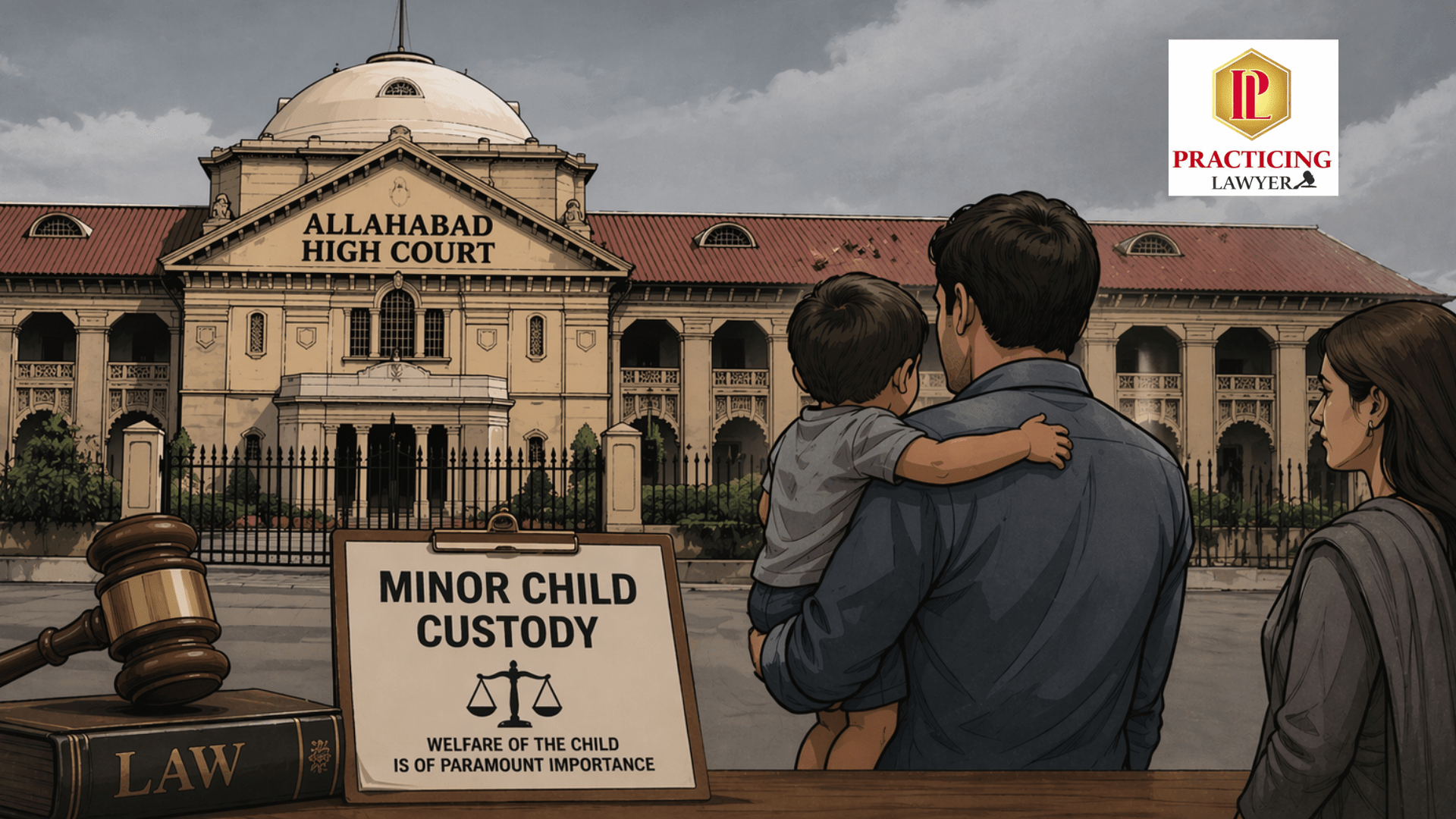
The Allahabad High Court stepped in to reunite a father with his 13-month-old infant in an emotional child custody dispute.
The Court held that a father cannot be deprived of his status as natural guardian merely because the child’s mother tragically died during a medical procedure.
The Court observed that,
“The mere fact that the death occurred during a failed IVF procedure cannot, in any manner, be attributed to any fault on the part of the petitioner so as to disentitle him from claiming custody of his minor child.”
The order was passed by a Single Bench of Justice Sandeep Jain while allowing a habeas corpus petition filed by Vipin Kumar Pandey. He was fighting to bring his infant son back home from the clutches of his in-laws.
The nightmare began in February 2025. Deepika Pandey, the petitioner’s wife, tragically lost her life during a failed IVF procedure. Following the sudden death, the 13-month-old boy ended up living with his maternal aunt and uncle.
Read also: https://practicinglawyer.in/allahabad-hc-dismissal-despite-acquittal/
The father soon approached the High Court to get his boy back. He laid out that he had solid finances and a clean criminal record to raise his son right. His sister, who lives nearby, also stepped up in court to promise her help in raising the toddler.
In this backdrop, the principal issue before the Court was whether the maternal relatives could legally hold onto the child just because they felt the father was somehow to blame for the tragic IVF outcome.
The in-laws tried to argue that the child, born prematurely, needed special care that only the aunt could provide. They even tried casting a dark shadow on the father’s character based on the medical tragedy.
Read also: https://practicinglawyer.in/allahabad-hc-upholds-life-term-burning-case/
Overruling this defense, the High Court relied extensively on the rulings of the Supreme Court. It brought up the landmark judgment in Tejaswini Gaud and Others vs. Shekhar Jagdish Prasad Tewari and Ors. (2019) 7 SCC 42. That ruling firmly established that when maternal relatives keep custody of a child without lawful authority, such custody amounts to illegal detention, thereby making a writ of habeas corpus fully maintainable.
The Bench also pulled from the recent Gautam Kumar Das vs. NCT of Delhi (2024) 10 SCC 588 decision. That case clearly established that handing temporary custody to relatives after a mother’s death does not wipe out a natural father’s absolute right to his kid.
Upon examining the record, the Court noted the absolute lack of any criminal allegations against the father. He found the father financially stable and more than capable of being a good parent.
The Bench also pointed out that the maternal grandmother was already 71 years old, raising serious questions about the long-term welfare of the infant if left with the in-laws.
The Court warned against the lasting emotional damage of keeping the toddler away from his surviving parent.
“If custody is not entrusted to the father at this stage, there is a real possibility of the child growing up without forming any emotional bond with him, which would be detrimental to the child’s overall development and the father’s parental rights” the Court noted, prioritizing the boy’s lifelong psychological well-being.
Accordingly, the Court allowed the petition and directed the maternal relatives to hand over the custody of the minor corpus to the petitioner in the court itself.
To keep the child’s bond with the mother’s side alive, the Bench granted the aunt and uncle visitation rights every Sunday evening for two hours.
Case: Akshit Pandey (Minor) And Another vs State Of U.P. And 6 Others
Case No: Habeas Corpus Writ Petition No. – 365 of 2025
Date of Order: 21.04.2026
Status: Allowed