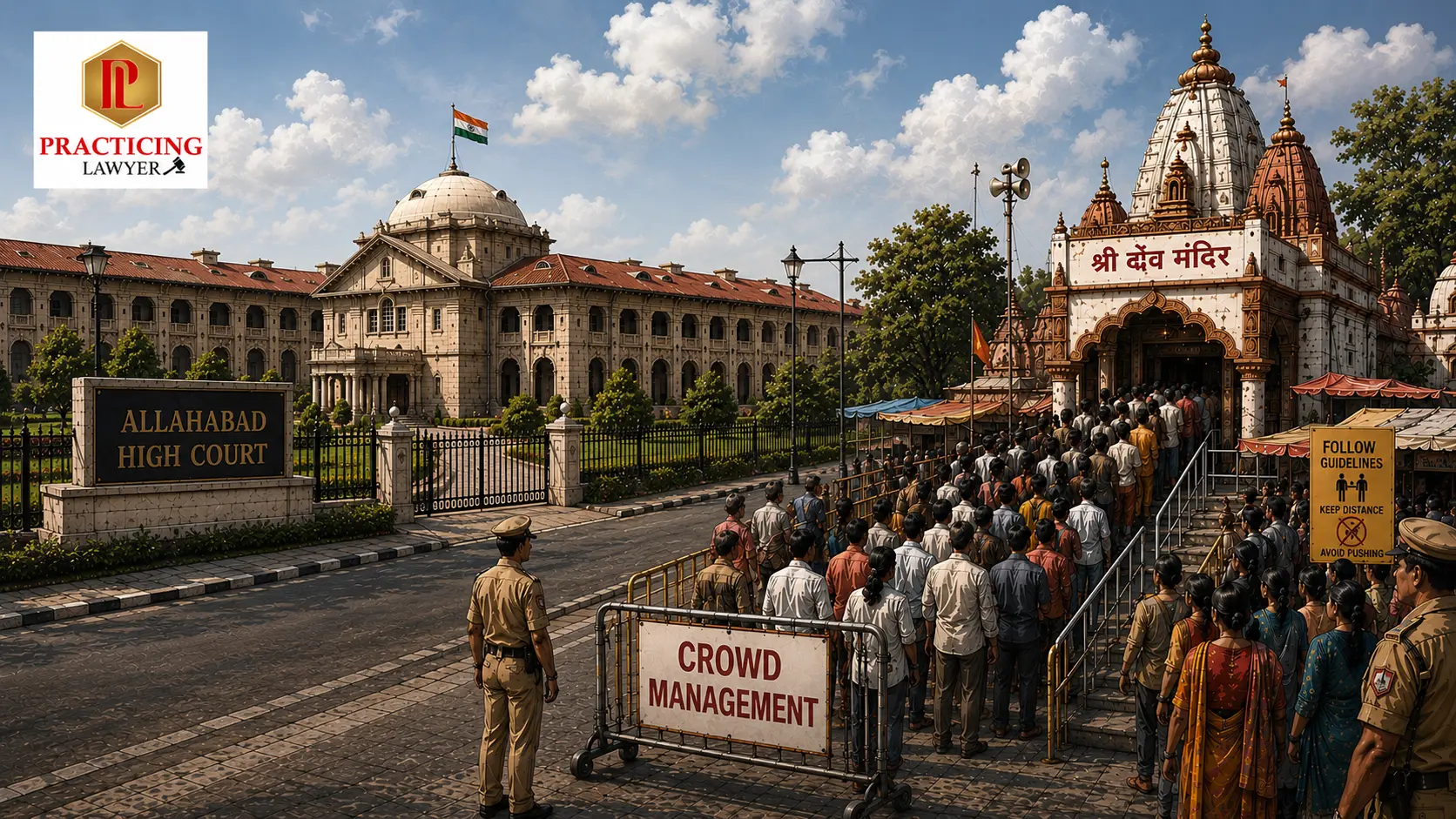
The Allahabad High Court has observed that effective crowd management at religious places goes far beyond police deployment, barricading and diversion.
The court noted that “no amount of deployment of police personnel, erection of barricades, traffic diversion or issuance of standard operating procedures will suffice to prevent the recurrence of such tragedies” unless the administration understands the science of crowd behaviour.
Stressing that crowd management is a far more complex socio-psychological issue than a mere law-and-order exercise, the Court found that “what is required is a fundamental paradigm shift: from reactive crowd control to proactive crowd behaviour research; from instinct-driven administration to evidence-based governance…”
It further held that “the institutionalization of crowd behaviour science – in academia, in administration, and in policy – is a constitutional imperative.”
Read also: Insurance Company Cannot Use Contractual Terms To Deny Welfare Compensation: Allahabad High Court
Justice Vinod Diwakar made the observations while hearing a petition filed by Swami Shiv Swaroopanand Ji Maharaj. The dispute before the court initially centred on the demolition of an alleged unauthorized structure at the petitioner’s Mathura Ashram.
According to the petition, the Mathura Vrindavan Development Authority was dissatisfied with the construction raised by the petitioner and later on passed a demolition order under Sections 27(1), 28(1) and 28(ii) of the U.P. Urban Planning and Development Act, 1973.
Further, the said order was dismissed on appeal by the Appellate Authority/Commissioner, Agra Division, Agra, on the ground that, despite being given sufficient opportunity of hearing, the petitioner failed to establish that the construction had been raised as per the approved sanction plan of the Mathura Vrindavan Development Authority.
The aforesaid order of the Commissioner was challenged in the present petition.
During the hearing, counsel for the petitioner argued that the action of the respondent was arbitrary and discriminatory, amounting to a case of “pick and choose” and demolition orders had passed against 23 persons for alleged unauthorized constructions. But proceedings have been initiated only against the petitioner and certain others, i.e., those persons placed at serial nos. 4, 9, 10 and 11 in the said list.
Earlier in the petition, the court directed the Mathura Vrindavan Development Authority to file an affidavit regarding the status and action taken against all 23 properties, the details of properties booked for unauthorized construction during the last five years, policy framework, statutory guidelines, standard operating procedures, etc.
During the earlier hearing, in compliance with the court’s order, the respondents (Vice Chairman, Mathura Vrindavan Development Authority; District Magistrate, Mathura; and SSP Mathura) filed their detailed compliance affidavit, which was discussed in detail in the order.
Read also: Arrest Without BNSS Compliance Set Aside, Orders for Release of the accused: Allahabad High Court
The court noted that the city of Mathura had faced incidents of stampede-like crowd crushes during the pre-Holi festival and other auspicious occasions, resulting in injuries, loss of consciousness, and casualties.
Significantly, the court clarified that,
“Unauthorized constructions had further aggravated the situation by obstructing rescue and emergency operations, as had been observed on several such occasions.”
The court widened the scope of the proceedings to examine larger issues of crowd management, urban planning and public safety in Mathura-Vrindavan.
The critical issues that were raised during the arguments from both the parties are the following:
(i) The Mathura Vrindavan Development Authority prepared its master plan for a period of ten years, which is inadequate for a city like Mathura, which has religious, cultural, and demographic significance.
(ii) Crowd management in the city has been reduced to little more than traffic management – a reductive equivalence that demonstrates a fundamental misunderstanding of the science and complexity of crowd behaviour.
(iii) Stampedes and crowd crush incidents happened due to the existence of narrow lanes and unauthorized constructions, along with other factors – a reason that addresses only the symptomatic indications of a far deeper and more firm planning and failure by government.
The Bench questioned with serious concern over the planning approach adopted for major pilgrimage cities, observing that “a city that is eternal in its religious significance cannot be governed by a planning document that expires in a decade”.
It further remarked that “the temporal inadequacy of the master plan is not a technical oversight – it is a governance failure of the first order”, adding that cities like Mathura, Ayodhya, Varanasi and Chitrakoot “cannot be placed at equal footing with the other cities in Uttar Pradesh.”
The court was of the view that universities in the state should introduce crowd behaviour and crowd management as dedicated academic disciplines.
It also suggested establishing a Centre of Excellence for Crowd Science, Mass Gathering Safety and Urban Risk Management with the support of IITs or other premier institutions and called for scientific crowd assessment to become an integral part of planning by development authorities and event organisers.
Examining the affidavits filed by the authorities, the Court found that while the administration had focused on traffic regulation and logistical arrangements, it had failed to undertake any meaningful scientific study of crowd behaviour.
The Court remarked that “the affidavits filed before this Court suggest, with troubling clarity, that they have not” – commissioned, conducted or even consulted scientific studies or computational models relating to major religious gatherings.
It further observed that “the study of crowd behaviour must be recognised not as an academic exercise but as an administrative necessity” and called for permanent multidisciplinary expert bodies at the district and divisional levels to undertake continuous research and risk assessment.
The court also made strong observations on unauthorized constructions in pilgrimage towns, holding that they are “not simply a product of poverty or ignorance; it is, in significant measure, a product of organized, politically facilitated, economically motivated illegality that has been allowed to accumulate over decades through a combination of institutional complaisance, regulatory capture, and political patronage.”
Stressing the State’s constitutional duty, the Bench observed that the right to life under Article 21 requires the State to create conditions in which lives are not lost to preventable disasters arising from administrative and intellectual unpreparedness.
Accordingly, the Bench has stayed the Agra Divisional Commissioner’s order dated 04.09.2025, and permitted the petitioner to file a fresh representation and also directed the authority to take a decision in terms of the state government’s latest circulars dated 15.01.2025, 17.01.2025 and 25.04.2026, as issued in compliance with the Supreme Court’s order dated 13.11.2024, passed in Writ Petition (Civil) No. 295 of 2022 in Re: Directions in the matter of demolition of structures and others.
Consequently, the court directed that a copy of its judgment be forwarded to the Chief Secretary of Uttar Pradesh, the Secretary of Higher Education, the Chairman of the University Grants Commission and the Secretary, Higher Education, Government of India, for appropriate consideration.
Case: Swami Shiv Swarupanand Ji Maharaj vs State of U.P. & 3 Others
Case No: WRIT C No. – 41777 of 2025
Date of Order: 22.07.2026
Status: Disposed of