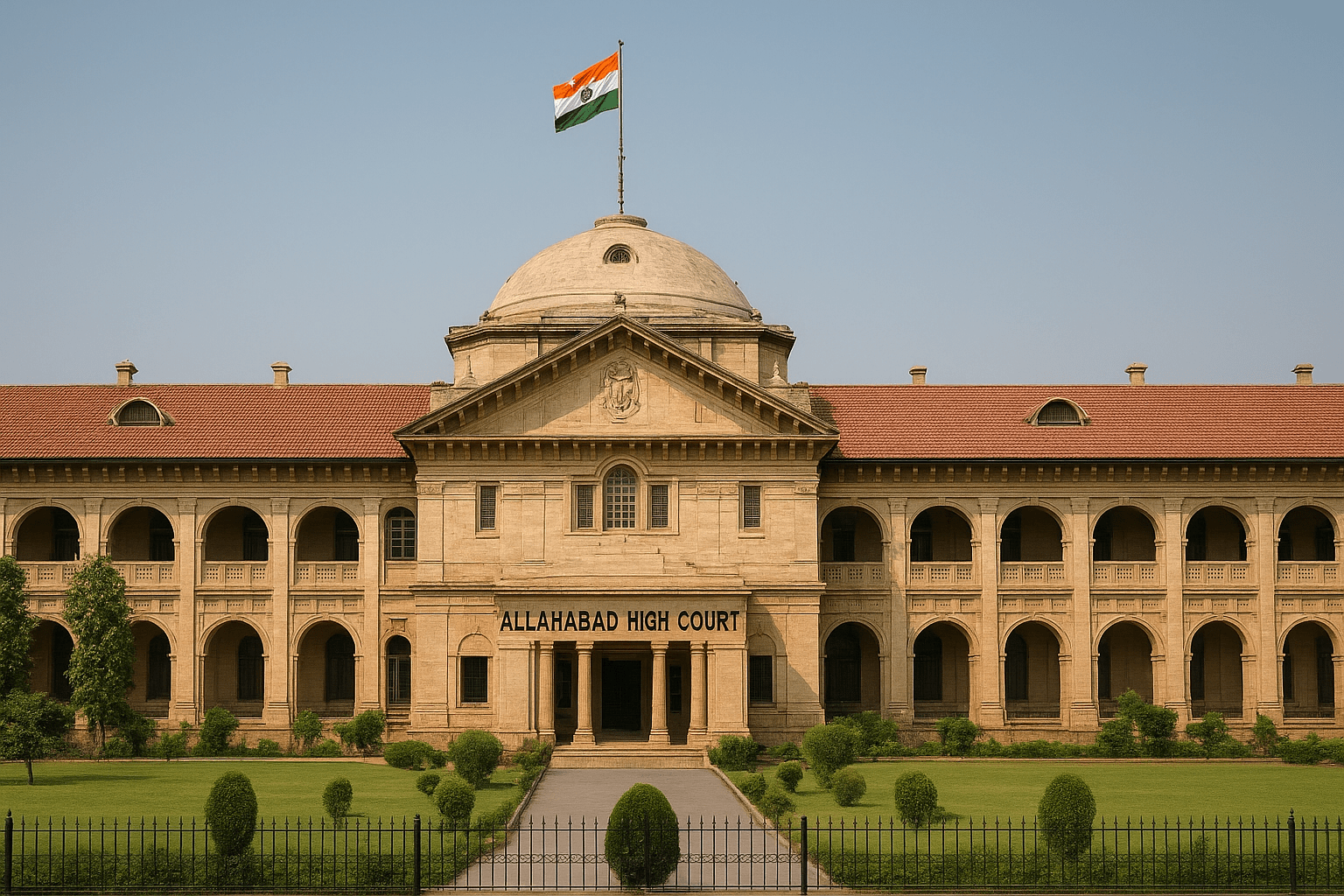
The Allahabad High Court, while delivering a significant judgment on serious allegations of manipulation in the public distribution system, has dismissed the petition filed by a fair price shop dealer from Ghaziabad. The Court did not accept the explanation that the ration for 697 cardholders was withdrawn using only three Aadhaar numbers due to technical glitches.
Terming it as a “clear case of black marketing and misuse of the system,” the Court observed:
“Technology advancement is beneficial to mankind, but its misuse can be detrimental to the society at large when used with wrong intention.”
In its detailed judgment, the Court also raised questions over the functionality of the State’s digital mechanism, Aadhaar authentication and the operation of the E-PoS machine. The Court clarified that the inquiry and records clearly established that, in July 2018, the machines were functioning in dynamic mode, where the data could be altered multiple times till it was locked at night. In such a scenario, the repeated use of the same Aadhaar number could not be considered a mere accidental error but appeared to be a “deliberate attempt”
The Court noted:
“Petitioner’s argument is only to the extent of static mode where the data becomes irreversible and gets locked, and there is no role of the dealer therein to get it altered or changed… But in the case in hand, the transaction took place while the process was in dynamic mode and not in static mode.”
These observations were made by a Single Bench of Justice Arun Kumar while dismissing the petition filed by Smt. Shahin Begum and nine others. The petitioners had challenged the FIR lodged on 28 August 2018 at Police Station Khoda, Ghaziabad, under provisions of the Information Technology Act, 2000, and the Essential Commodities Act, 1955, as well as the cancellation of their fair price shop license.
Counsel for the petitioner argued that the discrepancy occurred due to technical malfunction of the E-PoS machine and Aadhaar authentication errors, and also submitted affidavits of 162 cardholders confirming that they had regularly received ration.
During the hearing, petitioners’s counsel also submitted that she filed reply on 30.10.2018, in which she denied any enquiry by Supply Inspector on 27.08.2018, and no spot inspection of shop was ever made, nor did any officer contact her and also stock was never checked by the Inspector. E-PoS does not have any mechanism wherein a fair price shop agent can access Aadhaar database of beneficiaries on the server of NIC to change Aadhaar Numbers and commit any manipulation.
On the other hand, Advocate General argued that enquiry conducted as per provisions given in Govt. Order dated 05.08.2019, cannot vitiate the impugned order, as the Govt. order is prospective to cancellation of fair price shop dealership of petitioner, by the order dated 10.01.2019. Conduct of the petitioner in distribution of essential commodities was not fair as in appeal before respondent no.3 she fairly claimed that E-PoS machine was never given to anyone, nor it was tampered.
However, the Court, while referring to the judgment passed by the Coordinate Bench in Awadhesh Kumar vs.
State of U.P. and others,
“The dealers taking advantage of this hybrid mode, had resorted to such illegal activities and syphoned off ration of dormant cardholders. They were aware that no enquiry would be conducted as the cards were dormant and no one would come up to make any complaint. But on verification of transactions it was found that using details of few Aadhaar numbers, ration of thousands of cardholders was withdrawn throughout the State of U.P.”
These facts surfaced during an inquiry conducted by the NIC across 43 districts, following which FIRs were registered against the involved fair price shop owners and government officials. Responding to the show-cause notice, the petitioners failed to satisfactorily explain how the ration for 697 cardholders was withdrawn using only three Aadhaar numbers.
Finally, the Court while rejecting the contention of the petitioner, held that without substantial evidence, it is neither justified to blame departmental authorities or the system, nor is the decision based merely on the FIR. Rather, the available records, inquiry reports and facts sufficiently establish the misconduct.
Case: Smt. Shahin Begum and 9 others vs State of U.P. and 5 others