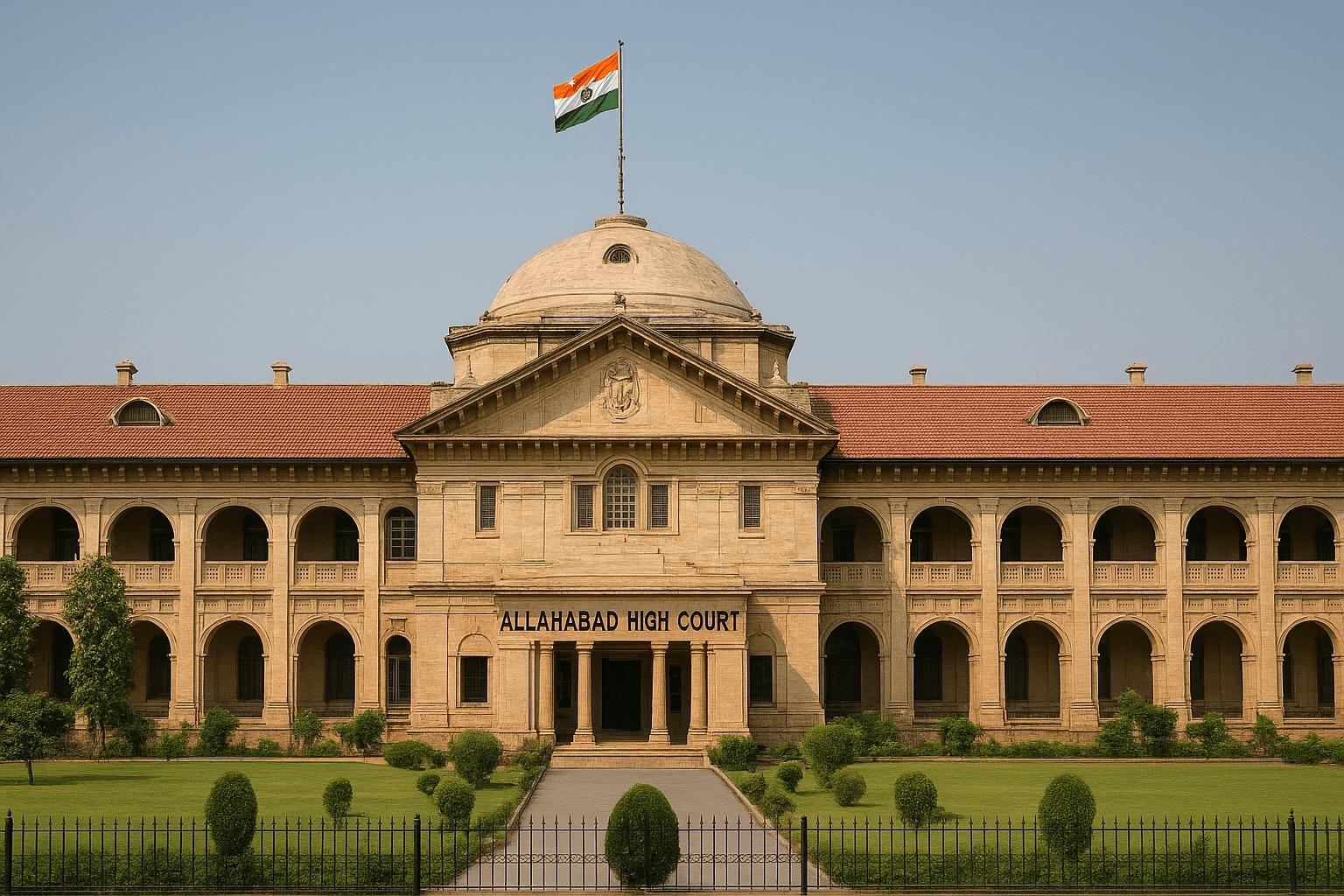
The Allahabad High Court has dismissed the criminal appeal challenging the acquittal of three accused persons in a 2018 assault case, holding that while the testimony of an injured witness generally carries high evidentiary value, the principle does not apply when the accused is also injured or when the testimony is inconsistent with medical evidence. The said order was passed by a Division Bench of Justice Rajeev Misra and Justice Dr. Ajay Kumar-II while upholding the acquittal in a case registered at Police Station Tajganj, Agra, under sections 307, 323, 504 and 506 of the IPC. The appeal had been filed by complainant Sanjay Kumar.
The Court observed in the following words:
“…………..law is well settled that the testimony of a single injured witness can be sufficient for conviction, if it is credible, trustworthy, and corroborated by other evidence. The testimony of an injured witness is given particular weight because such a witness is less likely to falsely implicate an accused, especially if the testimony is consistent and supported by medical or other evidence………………”
During the hearing, the Bench found significant contradictions between the witness’s statement and the medical report. While the complainant claimed that three of his fingers were cut by a knife blow, the medical examination revealed only one sharp-edged injury and other injuries caused by a blunt object. The Bench observed that “………….the version of manner of incident as narrated by the complainant does not find support from medical evidence available on record…………”
The Bench also noted that one of the accused had sustained injuries and undergone medical examination the same day, but the complainant concealed this fact in both his complaint and examination-in-chief. It also emerged that the accused not the complainant had called the police, and proceedings under Sections 107/116 Cr.P.C. were initiated against both sides, a fact again suppressed by the complainant.
The incident occurred on May 28, 2018, and the complaint was filed after an unexplained delay of 16 days. The Court reiterated the settled principle that unexplained delay in initiating criminal proceedings is fatal to the prosecution.
Further, although the complainant named several eyewitnesses, none were produced during the trial, despite two of them having been examined at the pre-summoning stage. The entire case ultimately depended only on the testimony of the complainant and the doctor who conducted the medical examination.
Besides this, the High Court relied on the Supreme Court judgment in Bharwad Jakshibhai Nagjibhai vs State of Gujarat, emphasizing that acquittal may be reversed only in very narrow circumstances. Further, the Court also cited the judgment passed in Babu Sahebagouda Rudragoudar vs State of Karnataka, reiterating that interference in order of acquittal is permissible only when the trial court’s decision is wholly unreasonable, perverse and contrary to the evidence on record.
Finding the testimony unreliable and the prosecution’s story doubtful, the Court noted that, “……………reasons recorded by Court below in support of it’s conclusion that prosecution has failed to establish the guilt of accused beyond reasonable doubt, are cogent and valid reasons…………” and thus, upheld the Sessions Court’s judgment dated 15.09.2025 by which the accused persons were acquitted and dismissed the instant criminal appeal of the complainant filed under Section 413 BNSS.
Case: Sanjay Kumar vs State of U.P. And Others