The Allahabad High Court has observed that a credible and reliable dying declaration by itself, is sufficient to sustain a conviction and that the rule requiring corroboration is merely a rule of prudence, not an absolute rule of law.
Emphasising the evidentiary value of such statements, the Court held that “a dying declaration, even if brief or short in nature, holds significant evidentiary value… The value of a dying declaration depends not upon its length but upon its truthfulness, clarity, and the conscious state of the declarant. The absence of elaborate detail does not diminish its legal sanctity. Whenever there is a brief dying declaration, it is indicative of the fact that it is neither the result of tutoring nor prompting. The shortness of the statement is itself a guarantee of its veracity.”
The ruling was delivered by a Division Bench of Justice Salil Kumar Rai and Justice Dr. Ajay Kumar-II while deciding a criminal appeal filed by Pawan Kumar against his conviction in a murder case.
An FIR was initially lodged at Ekdil Police Station, Etawah, under Sections 354, 452 and 307 of the IPC. Following the death of the victim during treatment, Section 302 IPC was subsequently added.
Read also: Patna Sessions Court Gives Khan Sir Interim Relief, Defers Arrest Till June 20
According to the prosecution, the 16-year-old girl, a student of class XI and a daughter of complainant had returned home from school and was changing her clothes. At that time younger son of the informant was present at the home.
It was alleged that the accused entered into the house of the complainant through the roof of a neighboring building.
It was also alleged that he attempted to outrage her modesty and, when she resisted, poured kerosene on her and set her ablaze and later on fled away from the roof of the house.
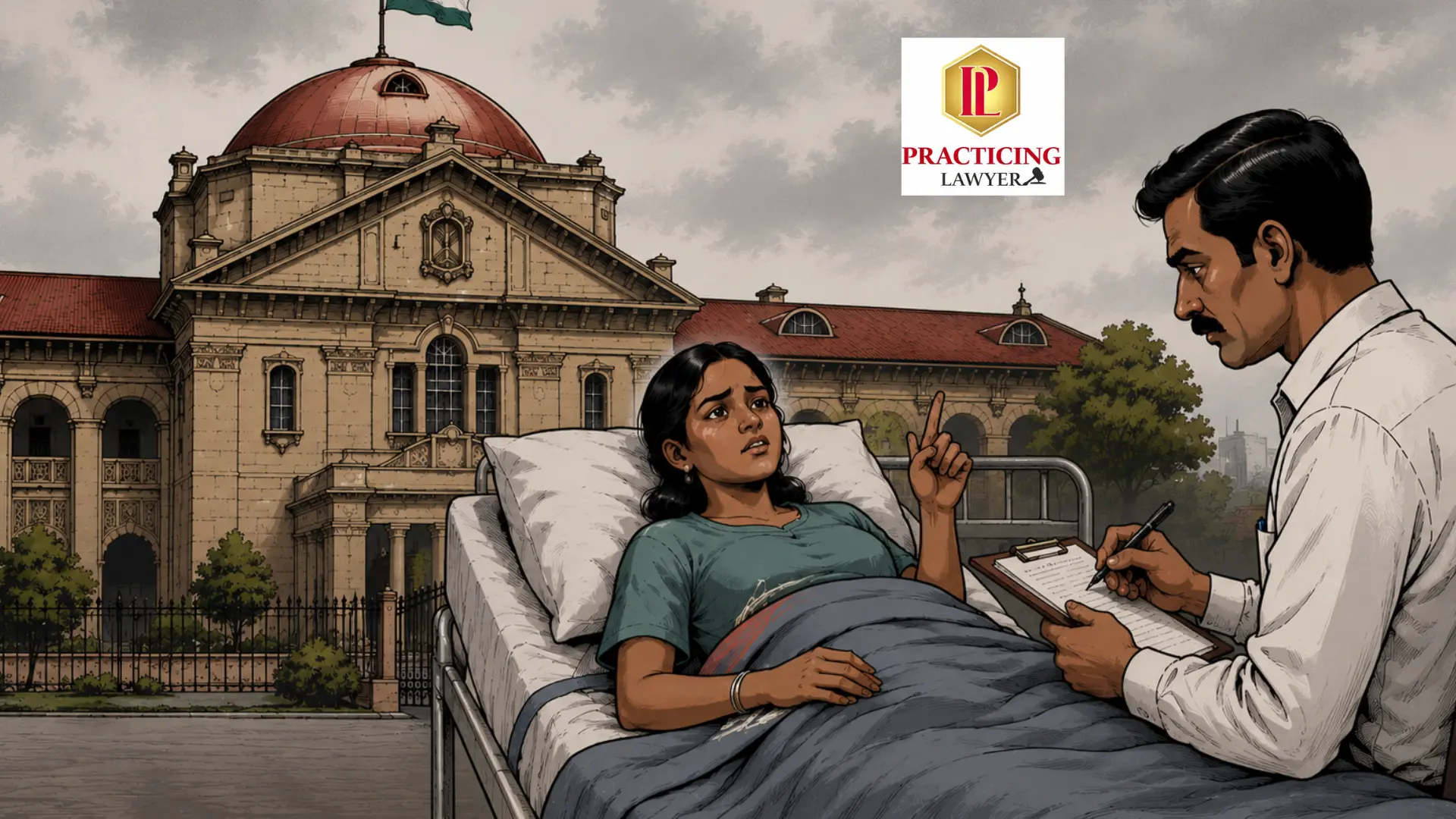
She was admitted to the Moti Jheel Hospital, Etawah, by the complainant, where her statement/dying declaration was recorded by the Naib Tehsildar on the same day. The victim was conscious at the time of recording of her statement.
She was later shifted to Ursala Hospital, Kanpur, where she succumbed to her burn injuries after six to seven days.
The autopsy of the deceased was conducted, and the doctor found that the cause of death of the deceased was due to septicemia.
Challenging the conviction, the counsel for the appellant argued that since the victim had died several days later due to septicemia, the offense would at best fall under Section 304 IPC and not Section 302 IPC.
It was also contended that the victim was not in a fit condition to make a statement and that reliance could not be placed upon the dying declaration.
Rejecting these submissions, the High Court noted that the victim’s statement had been recorded within two and a half hours of the occurrence. She was in a fit state to give a statement. Only thereafter did the Naib Tehsildar record her statement.
Further, fitness certificates had been obtained from the Emergency Medical Officer both before and after recording the statement.
Regarding dying declaration, the Court noted that,
“is admitted in evidence on the principle of “Nemo moriturns proesumitur mentiri i.e. a man will not meet his maker with a lie in his mouth. Dying declaration does not require any corroboration as long as it creates confidence in the mind of the Court and is free from any form of tutoring.”
The Bench recorded that the victim had specifically named Pawan Kumar (accused) and had briefly yet precisely described the manner in which the incident had occurred.
The Court found the dying declaration to be “brief, precise and reliable” and held that it was sufficient by itself to sustain the conviction.
Significantly, the Bench noted that,
“Normally the court looks to the medical opinion about the fit condition of the declarant at the time of making the statement. But this cannot be an inelastic rule. If the person who records the statement or the witness to the declaration tenders satisfactory evidence as to the fit mental condition, the Dying Declaration will be accepted.”
The Court further observed that although a dying declaration is ordinarily recorded in a question-and-answer form, the mere fact that it is not elaborate or is not in such a format cannot be a ground to doubt its acceptability or reliability.
The Court also ruled that,
“The victim has clearly stated that the appellant – convict was scuffling with her. The victim has stated that when she resisted and screamed, then appellant – convict set her on fire. The victim has not stated that how she was set on fire i.e. whether any kerosene oil or any other inflammable material was poured upon her or not.”
The Bench held that the dying declaration and medical evidence sufficiently established the prosecution case.
However, since the victim herself had not alleged molestation in her dying declaration and the testimony of her younger brother was found unreliable owing to doubts about his presence at the scene, the Court concluded that the charge under Section 354 IPC against the appellant could not be proved by the prosecution.
Accordingly, the Court acquitted the appellant in pursuance of Section 354 of IPC and thus, the instant appeal is partly allowed with certain directions.
Case: Pawan Kumar vs State of U.P.
Case No: Criminal Appeal No. – 4280 of 2011
Date of Order: 26.05.2026
Status: Partly allowed