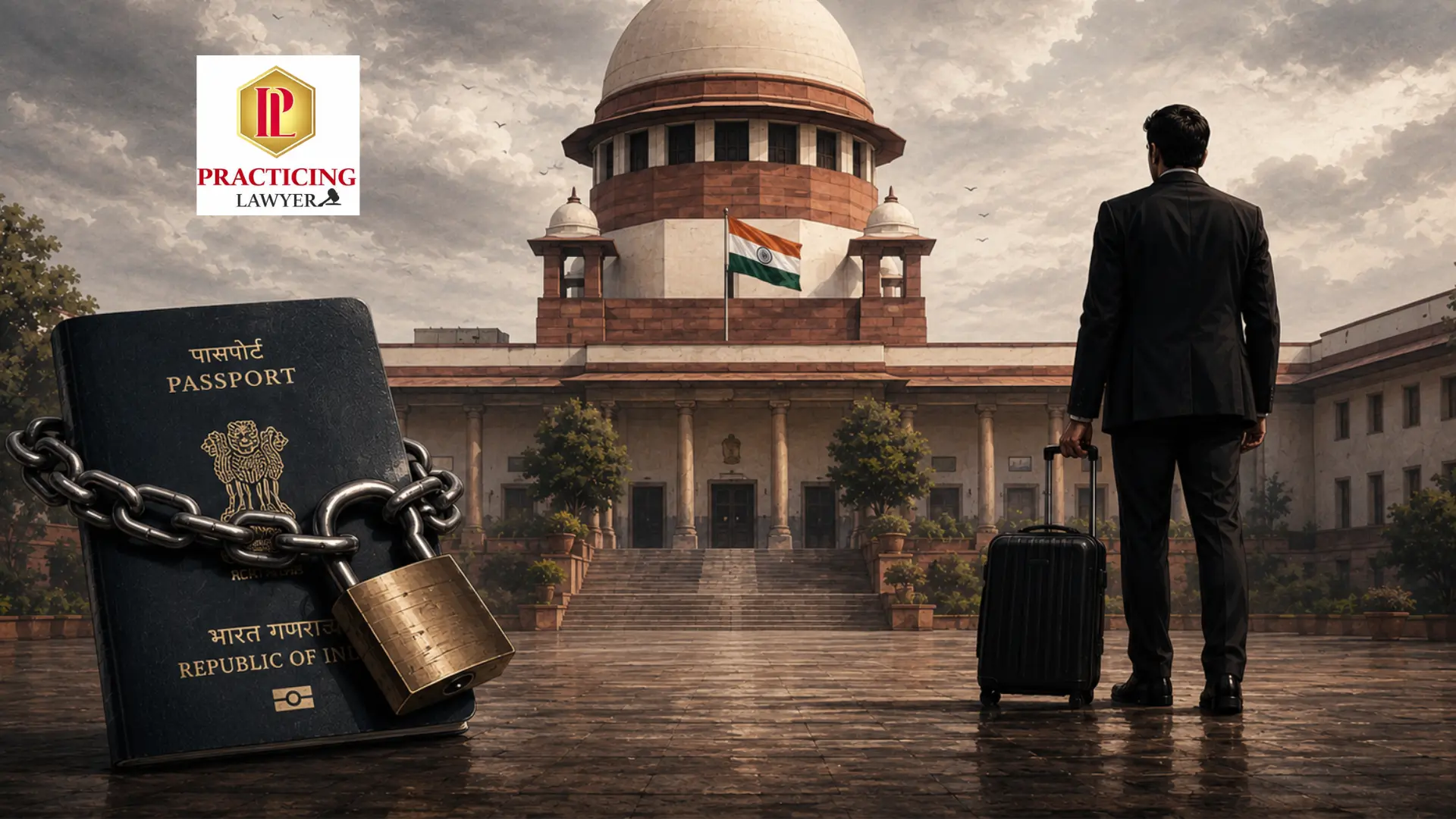
Holding that personal liberty cannot be viewed in isolation from the larger interests of justice, the Supreme Court has ruled that an accused person’s right to travel abroad must be balanced against the victim’s right to a speedy trial and society’s interest in the proper administration of criminal justice.
The Court observed that “the right to a speedy trial is equally an integral facet of Article 21,” and emphasised that “a balance must be struck between the individual liberty of the respondent no. 2 on the one hand and the right of the appellant to a speedy trial together with the larger societal interest in ensuring the effective administration of criminal justice, on the other.”
The order came from a Bench of Justice Dipankar Datta and Justice Satish Chandra Sharma while deciding an criminal appeal filed by Seesa Santosh against the State of Telangana and another.
The appeal questioned the legality of a Telangana High Court order that had restored the release of the respondent’s passport and permitted him to return to the United States subject to certain conditions.
The criminal proceedings have their roots in a complaint lodged on October 12, 2014, over the suspicious unnatural death of the appellant’s father.
Read also: Supreme Court Quashes DV Case; Slams Abuse of Mediated Settlement and Dissolves Marriage
An unnatural death case was initially registered under Section 174 of the Code of Criminal Procedure before the investigation led to FIR No. 173 of 2014 for offences punishable under Sections 120-B and 306 read with Section 34 of the Indian Penal Code.
The respondent was later charge-sheeted in the case on February 29, 2016.
Looking at the sequence of events, the Supreme Court noted that the criminal case had remained stuck for years despite the filing of the charge sheet in 2016.
The trial had still not begun, with the matter continuing at the stage of committal.
The Bench observed that delay in a criminal case cannot automatically be laid at the doorstep of the accused, but the record in the present matter revealed that the respondent had repeatedly moved the High Court and obtained interim reliefs at different points in time.
The Bench also took note of another aspect that weighed with them. More than once, proceedings initiated by the respondent were withdrawn before they could be decided on merits, after interim protection had already been secured.
In the Court’s view, this pattern naturally gave rise to questions about the respondent’s bona fides and the manner in which the judicial process had been invoked over the years.
According to the Bench, such conduct raised legitimate doubts regarding the respondent’s bona fides, particularly when interim orders had the effect of stalling the criminal process for years together.
It also took note of allegations that the respondent had left the country after obtaining suspension of the Look Out Circular, though the Court refrained from recording any conclusive finding on that issue.
Rejecting the argument that overseas medical treatment justified unrestricted foreign travel, the Bench observed that medical facilities available in India are comparable to those available abroad.
In its view, the High Court had adopted an overly indulgent approach by permitting the respondent to leave the country merely because he had appeared before the Magistrate on previous occasions and had undertaken to return within six months.
Even so, the Supreme Court did not agree with the Sessions Court’s insistence on compulsory surrender of the passport.
Instead, it restored the Magistrate’s order while making it clear that the respondent would not be free to leave India as a matter of right.
Any future request for foreign travel, the Court said, must be placed before the Sessions Court after committal of the case, which would be at liberty to impose suitable conditions before granting permission.
The Bench further directed the civil authorities, police and airport administration to coordinate and ensure that the respondent does not fly out of the country without express approval from the Sessions Court.
It clarified that the observations contained in the judgment are confined to the issue under consideration and should not influence the merits of the pending criminal case.
Case: Seesha Santosh vs The State of Telangana And Anr [Arising out of SLP (CRL) No. 18022 OF 2025]
Case No.: Criminal Appeal No. 003048 of 2026
Date of Order: 04.06.2026
Status: Disposed of