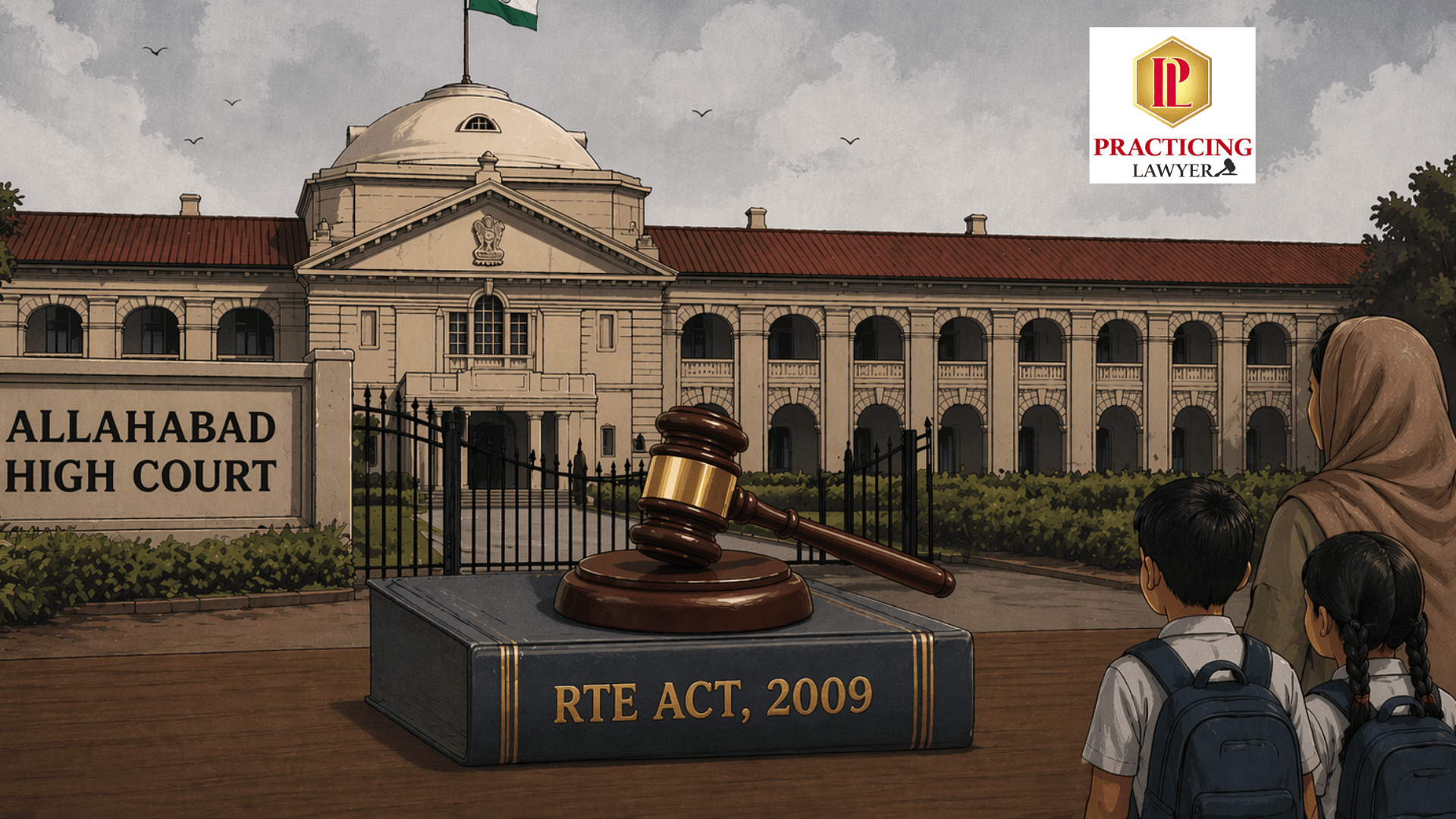
The Allahabad High Court, in a significant ruling, has struck down the State’s arbitrary refusal to accept manual applications for admissions under the Right of Children to Free and Compulsory Education Act, 2009.
Emphasizing the constitutional mandate of free and compulsory education, the Court found that an exclusively online process cannot act as a barrier for disadvantaged groups and weaker sections.
The Court further noted that the government must look into the reasons and should provide remedial measures so that the benefit of aforesaid Act, 2009 is extended to maximum students.
The Court observed that,
“The very object of the Act, 2009 shall stand defeated, if the parents who are unable to apply through online mode, are put to restrain by not even making an application manually; and as such the argument of the State that the application ought to have been made only through online mode cannot be accepted; and is accordingly rejected.”
The order was passed by a Single Bench of Justice Siddharth Nandan while disposing of a writ petition filed by a minor, Khwaja Asher. The minor was represented by his guardian Khwaja Shamshad Ahmad in a legal battle against the State of U.P. and others.
The young petitioner aggressively sought admission to Class Nursery under Section 12(1)(c) of the Right of Children to Free and Compulsory Education Act, 2009.
Back in April 2023, his family manually submitted an application to the Basic Siksha Adhikari (BSA) in Prayagraj. They cited an absolute inability to navigate the online web portal.
Read also: https://practicinglawyer.in/uttarakhand-hc-father-child-maintenance-duty/
Despite a 2016 government order explicitly permitting manual submissions through the BSA for offline parents, the State authorities pushed back. Relying on subsequent departmental letters from 2017 and 2023, the government argued that the entire admission mechanism had completely shifted to an online-only system.
In this backdrop, the principal issue before the Court was whether the State could completely shut its doors on offline applications for RTE admissions. Does a rigid digital-only mandate violate the core spirit of the RTE Act and alienate the very demographics it seeks to protect?
Upon examining the record, the Court dismantled the government’s harsh stance. It noted that the 86th Constitutional Amendment Act, 2002, which inserted Article 21-A, strictly obligates the State to ensure equitable education for all.
A purely online system effectively sidelines disadvantaged groups who severely lack internet access or digital literacy.
The Bench pointed out that the 2017 letter introduced the online system as an “also” option. It never intended to scrap the manual pathway established in 2016.
The State’s submissions regarding mandatory submission of applications online specifically defeat the Directive Principles of State Policy aiming to provide free and compulsory education to children.
Significantly, the Court expressed deep concern over startling, ground-reality admission statistics.
It noted an inherent defect in the implementation of the benefits of the Act, 2009, observing that over 1,300 children allotted schools across two academic sessions simply failed to secure admission.
The Court highlighted that,
“….for example in Ananta Devi Girls Inter College, only one student has been given the benefit; in Astha Vidya Mandir, only two students have been given the benefit in Bal Vikas Vidyalaya, only four students, and similarly the numbers are between 1 to 4 in each school is overwhelming in the entire list, brought on record by the respondents.”
While acknowledging that online mechanisms bring transparency, the Court firmly remarked that,
“the State Government must also take upon itself, the onerous duty to facilitate the parents, to file online application through the office of Basic Siksha Adhikari; and any other method, would defeat the very purpose of the Act, 2009.”
Accordingly, the High Court allowed the writ petition and strictly directed the BSA, Prayagraj, to process the child’s application within one week.
The Court additionally ordered the State Government to circulate the judgment to all the District Basic Siksha Adhikari of the State and, for necessary compliance frame a formal Standard Operating Procedure (SOP) to assist incapable parents in applying via local BSA offices.
Case: Khwaja Asher (Minor) Khwaja Shamshad Ahmad vs State Of U.P. And 4 Others
Case No: WRIT – C No. – 34106 of 2023
Date of Order: 24.04.2026
Status: Allowed