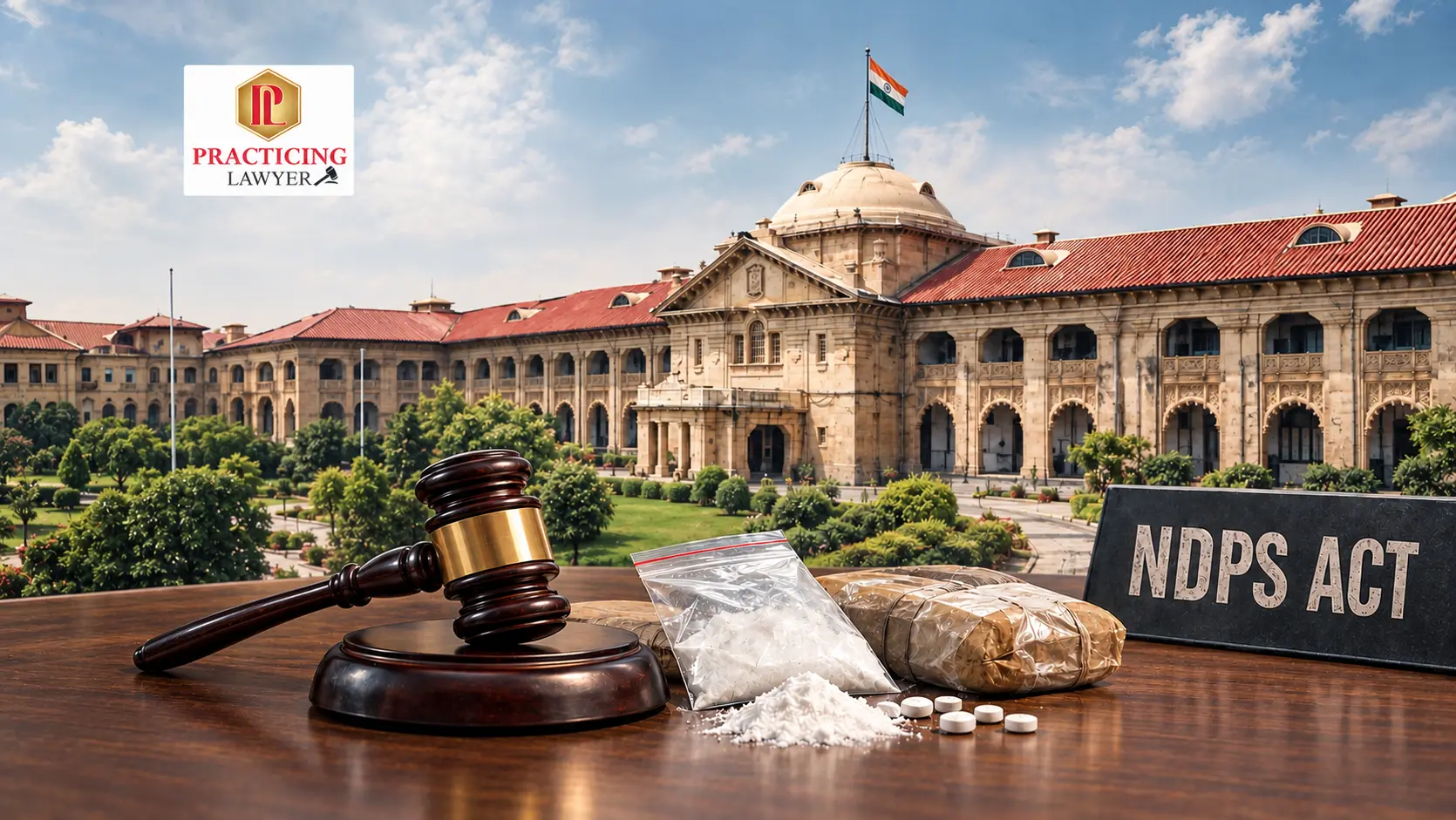
The Allahabad High Court, Lucknow Bench, ruled that a general diary omission does not automatically make an arrest illegal when procedural safeguards are met.
The court observed that “procedural omission or a failure to record the information in the general diary does not automatically render the foundational arrest illegal, in its entirety.”
It further held that “the law always prioritize the substantial compliance over a procedural or technical compliance, therefore, a technical defect or irregularity in a document may not invalidate the entire proceeding if the substantial compliance has been made.“
With the above observation the court dismissed the habeas corpus petition filed by 13 persons arrested in an alleged organised cyber fraud call centre case.
The judgment was delivered by Justice Rajnish Kumar and Justice Mrs Babita Rani on a habeas corpus petition filed by Karolyn @ Caroline Kharnaior and other accused persons.
The petitioners had challenged their arrest and the remand order dated July 2, 2026, relating to Case Crime No. 0078 of 2026.
In the case, FIR was registered at Cyber Crime Police Station, District Lucknow, under various sections of BNS, Sections 66C and 66D of the Information Technology Act and Section 42(2) of the Telecommunication Act, 2023.
The case arose when police conducted a raid on June 30, 2026, at about 10.30 pm at the 11th floor of Summit Building, Vibhuti Khand, Gomti Nagar, Lucknow, following secret information about an alleged illegal cyber call centre targeting foreign nationals.
Read also: Allahabad HC Stays Three-Member Benches for Land Cases
The police found 119 persons, including 92 men and 27 women, working there and seized 103 laptops, 99 mice, 116 headphones, 111 laptop chargers, 68 iPhones, 109 personal mobile phones, a biometric machine and routers.
According to the FIR, the centre operated through different teams and allegedly impersonated officials of the US Treasury, Federal Trade Commission, FBI and US District Courts to obtain bank details and money from victims.
The petitioners argued that they had been illegally detained for about 36 hours, and arrest memos did not contain the grounds and reasons for arrest or bear their signatures.
They also submitted that their family members were not informed immediately after the arrest and remand order was passed mechanically.
The State, however, contended that the arrest and recovery memos were prepared at the place of occurrence.
Besides this, the recovery memo, containing the grounds and reasons of arrest, was also furnished to petitioners and signed by them.
The bench rejected the allegation of detention beyond 24 hours, noting that the raid involved 119 persons and a large number of electronic devices.
The police informed the concerned police station at 5 pm on July 1, and FIR was lodged at 9.20 pm, while the initial investigation continued till 2 pm on July 2.
Further, the petitioners were produced before the remand magistrate.
“The allegations of illegal detention beyond 24 hours is not substantiated by the record and is therefore rejected,” the court held.
The court noted that although the arrest memo did not contain a receipt signed by the petitioners, the recovery memo, prepared contemporaneously with the arrest, contained detailed grounds and reasons for arrest, and copies were furnished to them.
The court held that the petitioners had thus come to know the grounds and reasons of their arrest by way of arrest memo and through recovery memo, which was prepared along with the memo of arrest and furnished to them spontaneously.
It observed that furnishing grounds of arrest is a mandatory constitutional safeguard, but in the instant case the requirement was substantially complied with through the recovery memo.
The court also examined Section 48 of the BNSS, which requires the police to inform relatives, friends or other nominated persons about an arrest and maintain a corresponding entry.
Read also: Arrest Without BNSS Compliance Set Aside, Orders for Release of the accused: Allahabad High Court
The State produced call detail records showing that calls had been made to the nominated persons before the petitioners were produced before the magistrate, although the corresponding entry in the General Diary was not shown.
The court held that complete compliance could not be demonstrated, but noted that the nominated persons had been informed by telephone and were residents of the North-Eastern states.
The court observed that the case diary and general diary had been placed before the magistrate, and remand was granted after perusal of material.
Though the said order was passed on a printed proforma and did not appear to contain complete details regarding compliance with Sections 47 and 48 of the BNSS, this could not invalidate the arrest when the furnishing of the grounds and reasons of arrest had been established.
Accordingly, the court found that the petition was devoid of merit and thus dismissed the petition on misconceived grounds.
It clarified, however, that “the dismissal of the petition shall not construe any expression of opinion on the merits of the case i.e. bail or trial or any other proceeding.”
It is pertinent to note that one of the petitioners, Amandeep Kaur, had already been enlarged on bail by the High Court, while bail applications of the other petitioners were pending after rejection by the concerned courts.
Case: Karolyn @ Caroline Kharnaior Thru. Her Father Paramjit Singh Chhabra and others vs State of U.P. Thru. Prin. Secy. Home Lko. and others
Case No: Habeas Corpus Writ Petition No. – 279 of 2026
Date of Order: 15.09.2026
Status: Dismissed