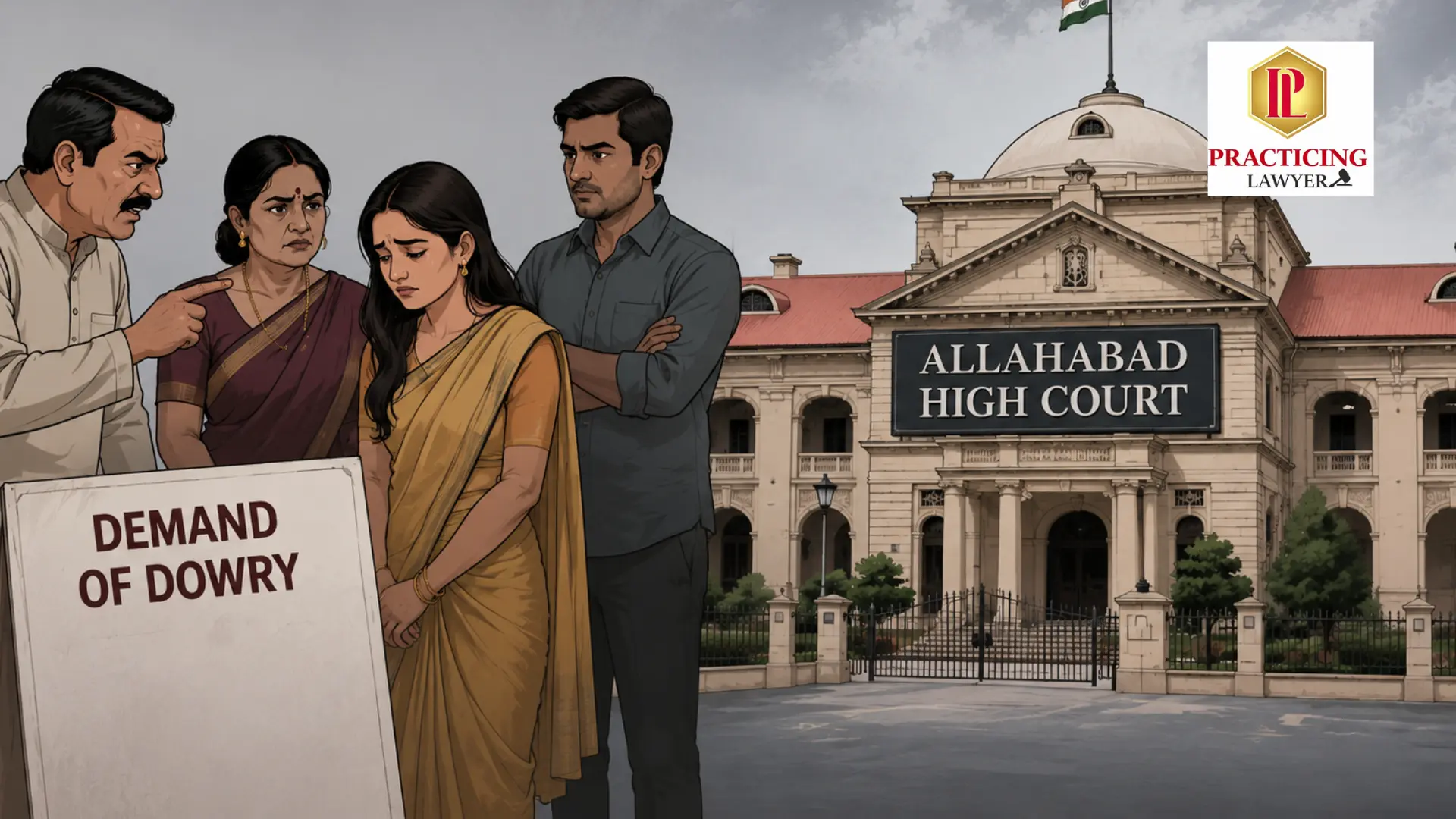
The Allahabad High Court has held that the mere fact that a woman died under unnatural circumstances within seven years of marriage and had allegedly faced harassment shortly before her death does not, by itself, make out a case of dowry death.
The Court observed that where the essential ingredient of demand for dowry is absent, the presumption under Section 113-B of the Indian Evidence Act would not arise and “no person can be charged merely on the basis of imagination.”
The ruling was delivered by Justice Lakshmi Kant Shukla while allowing a criminal revision filed by Smt. Meena Devi and another.
Read also: Reliable Dying Declaration Sufficient to Sustain Conviction
The petition challenged the order dated January 6, 2026, passed by the Sessions Judge, Kanpur Nagar. The case arose out of Case Crime No. 75 of 2025 registered at Govind Nagar Police Station, Kanpur Nagar, under Sections 85 and 82(2) of the Bharatiya Nyaya Sanhita, 2023 and Sections 3 and 4 of the Dowry Prohibition Act, 1961.
According to the prosecution, the deceased died under unnatural circumstances within seven years of marriage. However, the post-mortem report could not immediately ascertain the cause of death, following which the viscera was preserved.
The forensic science laboratory report revealed the presence of poisonous substances in the viscera, thereby confirming poisoning as the cause of death.
Read also: Patna Sessions Court Gives Khan Sir Interim Relief, Defers Arrest Till June 20
The Court noted that the deceased’s parents-in-law, who are the present revisionists, were residing in their native village, whereas the deceased had been living with her husband in a rented accommodation in Kanpur city.
The case diary contained an audio recording of the conversation between the deceased and the informant, which, according to the Court, completely falsified the allegations relating to the dowry demand and suggested that the motive behind the death was different from the one alleged in the FIR.
The deceased, during the conversation, repeatedly blamed co-accused Rahul and his wife Sonam and stated that they had made her life miserable.
The statement of the landlord, Shashi Kant Tiwari, also revealed that frequent quarrels used to take place between the deceased, her husband and the other two co-accused persons namely Rahul and his wife Sonam.
According to him, the disputes were not related to dowry demands but arose because Rahul and Sonam were living in the same rented premises.
Referring to these materials, the Court observed that although the death had occurred within seven years of marriage and the deceased had allegedly suffered harassment before her death, the indispensable element of demand for dowry was conspicuously absent.
Consequently, the statutory presumption under Section 113-B of the Evidence Act, 1872 was not attracted.
The Court further emphasized that while exercising powers under Section 227 CrPC, 1973 (corresponding to Section 250 BNSS, 2023), the court is required to evaluate the entire material and statements recorded in the case diary in their true and proper perspective.
It observed that statements based merely on hearsay “must be discarded” whereas statements corroborated by other material deserve greater weight than unsubstantiated allegations.
The Bench added that,
“And the Court should proceed further on the basis of statement with corroborative materials disregarding statements having no supportive material.”
Finding that the trial court had failed to appreciate the evidence in its proper perspective, the High Court held that the impugned order suffered from “material irregularities and illegalities.”
Accordingly, it set aside the impugned order dated January 6, 2026, and remanded the matter to the trial court with a direction to pass a fresh order in accordance with law.
Case: Smt Meena Devi and Another vs State of U.P Through Principal Secretary (Home) And Another
Case No: Criminal Revision No. – 369 of 2026
Date of Order: 13.05.2026
Status: Allowed