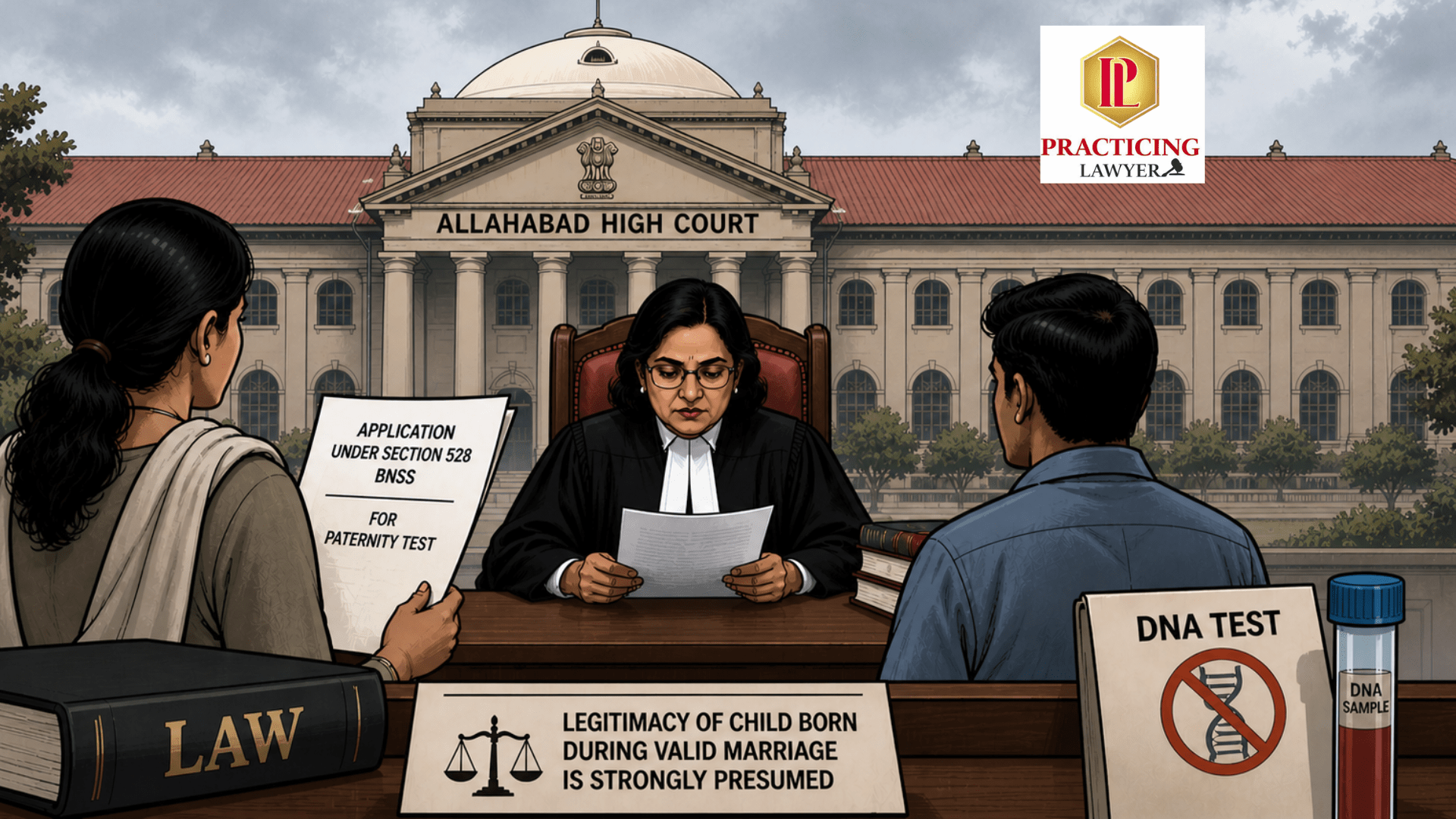
In a recent ruling, the Allahabad High Court made it clear that courts shouldn’t just order DNA tests on a whim to settle paternity disputes. When a child is born to a legally married couple, the law automatically considers the child legitimate.
The judges pointed out that vague suspicions or simple accusations aren’t enough to shake this rule.
Legally speaking, the husband is firmly presumed to be the father, and overcoming that hurdle is incredibly difficult. It clarified that the presumption can be rebutted only if the husband proves, with cogent evidence, complete “non-access” to his wife at the time of conception.
The court submitted that,
“Even if it is presumed that applicant no.1 developed extra-marital relationship with opposite party no.2, especially when applicant no. 2 was begotten, such a fact, per se, would not be sufficient to displace the presumption of legitimacy. It seems that the husband and opposite party no. 2 both had simultaneous access. There being a statutory mandate, the applicant No. 2, Master Shiva shall be presumed to be the son of Narendra Tyagi. “
On this basis, the Court ruled that a mother cannot compel her alleged paramour to undergo a DNA test when the child was born during a subsisting valid marriage.
Read also: https://practicinglawyer.in/allahabad-hc-dismissal-allowed-pension-rights-upheld/
The order was passed by Justice Nand Prabha Shukla while dismissing a criminal application filed under Section 528 of BNSS by Smt. Mansi Tyagi and another.
In the instant application, the applicant has challenged the decision given by the learned Additional Principal Judge, Family Court No.1, Agra, on January 19, 2026. In that said order, the Court rejected the application filed by the applicant for the determination of the paternity of her begotten son Master Shiva (applicant No. 2) through a DNA test by taking the blood samples of her son and opposite party No. 2, Satish Tiwari, in the pending maintenance proceeding under section 125 Cr.P.C.
The Court placed reliance on recent Supreme Court ruling as passed in R. Rajendran vs. Kamar Nisha, 2025 INSC 1304, observing that Section 112 of the Indian Evidence Act serves as a strong legal safeguard against casually questioning a child’s legitimacy, “stands as a bulwark against the casual illegitimization of children on the strength of unsubstantiated allegations or mere suspicion.”
Read also: https://practicinglawyer.in/allahabad-hc-stays-teacher-redeployment-drive/
According to the facts of the case, the petitioner was solemnized with Narendra Tyagi in 2012, and the couple had two sons. In 2018 -19, she allegedly entered into an extramarital relationship with Satish Tiwari, resulting in the birth of a third son, Shiva, on July 12, 2020.
A paternity test was conducted by the husband himself, and the DNA Test report dated July 28, 2020, revealed that he was not the biological father of the child, following which he filed a divorce petition for dissolution of the marriage, which is still pending.
Thereafter, the applicant filed a maintenance petition before the Principal Judge, Family Court, Agra under Section 125 CrPC for the minor child. During the pendency of the petition, she filed an application pressing for a DNA test to prove Satish Tiwari’s paternity.
The Family Court, however, declined the request, observing that no reliable material was placed on record to establish a live-in relationship between them.
After examining the record, the High Court observed that the child was born during the subsistence of a valid marriage when the husband and wife were living together. Therefore, the presumption of legitimacy under Section 112 remains conclusive and binding.
The Court reiterated that,
“Forcefully undergoing a DNA test would subject an individual’s private life to scrutiny from the outside world. That scrutiny, particularly when, concerning matters of infidelity, can be harsh and can eviscerate a person’s reputation and standing in society.”
In conclusion, the Court held that the Family Court’s order was legally sound and found no justification to interfere with it.
Accordingly, the application was dismissed.
Case: Smt. Mansi Tyagi And Another vs State of U.P. and Another
Case No: Application u/s 528 BNSS No. – 10028 of 2026
Date of Order: 04.05.2026
Status: Dismissed