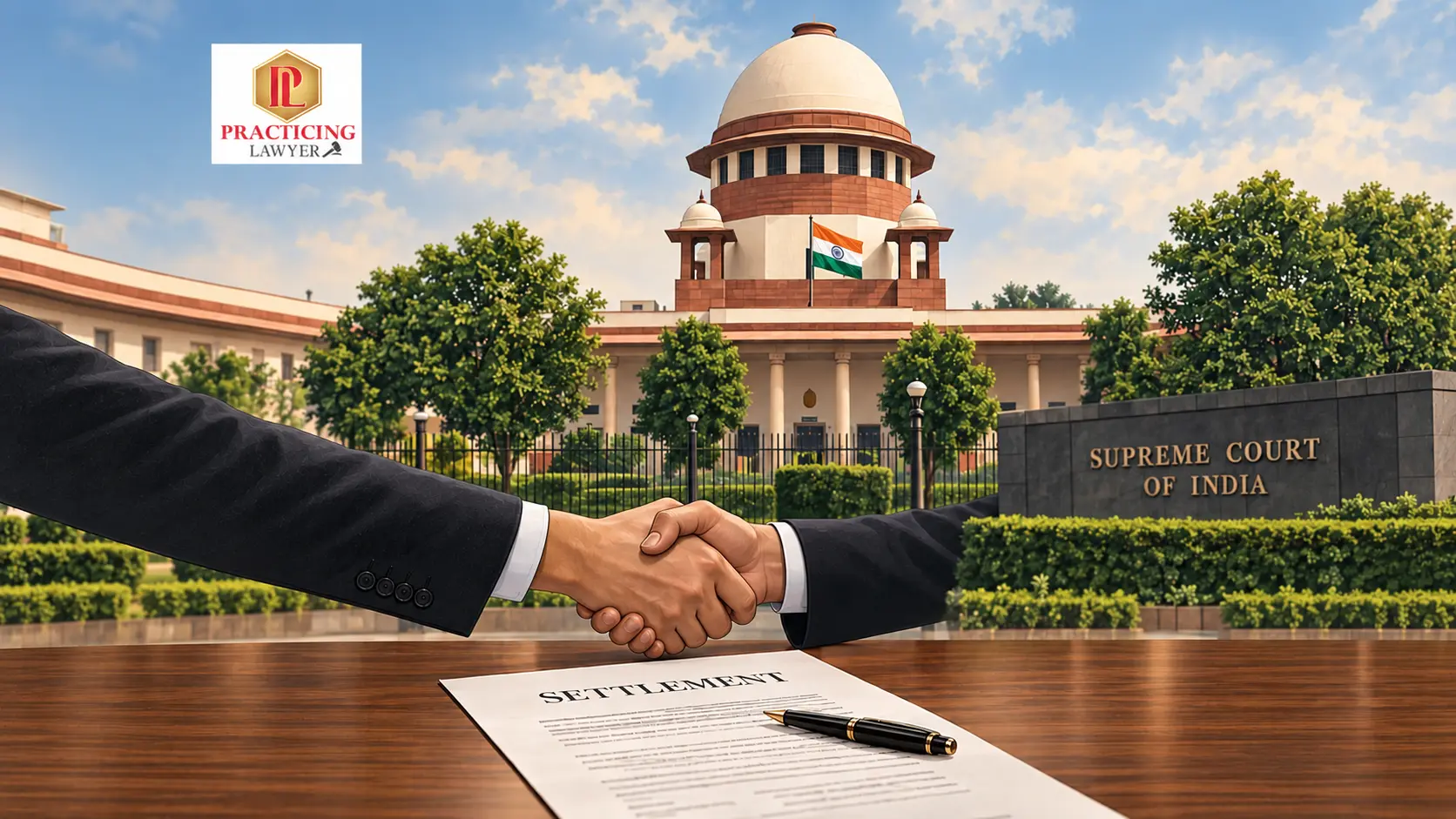
The Supreme Court has held that proceedings under the Protection of Women from Domestic Violence Act, 2005, cannot be used to revive monetary or maintenance claims voluntarily relinquished under a settlement agreement.
Observing that “the proceedings under the DV Act constitute an abuse of process”, the Court ruled that once a wife had voluntarily relinquished all monetary claims, including maintenance, “revival of such claims through subsequent proceedings cannot be permitted.”
The judgment was delivered by a division bench of Justice Sandeep Mehta and Justice Manmohan on an appeal filed by Reji Baby, challenging the Kerala High Court’s refusal to quash the domestic violence proceedings initiated by Subi Mary and others.
The dispute arose after the appellant-husband and respondent No. 1 wife entered into a Settlement Agreement on July 23, 2016, agreeing that neither would make any monetary claim against the other and that the wife would not claim maintenance from the husband.
Read also: Only the Real Victim Can Authorize Settlement for Quashing Criminal Proceedings: Supreme Court
They subsequently filed a joint application for divorce by mutual consent under Section 10A of the Divorce Act, 1869, and obtained a divorce decree on January 30, 2017.
The husband contended before the Supreme Court that the domestic violence proceedings sought to reagitate claims which had already been extinguished by the settlement.
The respondents, however, stated that the wife had agreed to forego her monetary claims but alleged that the agreement had been executed under duress.
They argued that the settlement, having waived statutory and fundamental rights, was void against public policy.
The Supreme Court rejected the challenge to the settlement. It noted that the wife had not only executed the Settlement Agreement but had also filed an affidavit before the Family Court on January 24, 2017, reiterating that she had relinquished her maintenance claim and that there would be no future claims or liabilities arising from the marital relationship.
The affidavit also expressly stated that the divorce petition had been filed out of the parties’ “free will, violation and desire” and that there was “no coercion or undue influence in filing this petition”.
The Court further noted that the respondents had not pleaded any fresh cause of action arising after the divorce.
The domestic violence complaint related to alleged acts which had taken place before the Settlement Agreement.
Read also: Right to Travel Abroad Cannot Override Fair and Speedy Criminal Trial: Supreme Court
It also found that although the respondents sought to challenge the settlement and divorce decree on the ground of duress, respondent No. 1-wife had not initiated any proceedings to set aside the decree or obtain a declaration invalidating the settlement.
“Mere averments of coercion, absent any legal challenge, cannot suffice,” the Bench observed, adding that the parties, being well educated and aware of their rights, must be deemed to have consciously and voluntarily executed the settlement agreement and joint divorce petition.
The Court also relied on its recent decision in Dhananjay Rathi v. Ruchika Rathi, 2026 SCC OnLine SC 587, where it deprecated the practice of initiating proceedings under the DV Act despite a valid compromise.
Referring to the principle laid down in that case, the Bench noted that once parties enter into a settlement agreement and agree to its terms, they remain bound by it, and any violation may give rise to consequential remedies in civil or criminal law.
Read also: Supreme Court Quashes DV Case; Slams Abuse of Mediated Settlement and Dissolves Marriage
At the same time, the Supreme Court made an important distinction regarding respondent No. 2, the daughter.
It noted that the settlement had been executed only between the husband and wife and that the daughter, who had attained majority before the agreement was executed, was not a party to it.
Therefore, “it cannot be said that respondents No. 2-daughter had waived her right to monetary claims.”
Allowing the appeal, the Supreme Court set aside the Kerala High Court’s October 26, 2018 order and quashed the proceedings in M.C. No. 23/2017 pending before the Judicial First Class Magistrate Court, Kalamassery.
It clarified that the daughter would remain at liberty to initiate fresh proceedings seeking monetary relief against the appellant, if so advised, in accordance with law.
Case: Reji Baby vs Subi Mary & Ors
Date of Order: 24.08.2026
Status: Allowed